
Blog Content
Why Finding the Right Coverage for Your Teen Matters More Than Ever
Best auto insurance for teenage drivers starts with understanding your options and the significant cost differences between policy types. When your teen gets behind the wheel in Maine, you're facing one of the biggest insurance decisions—and expense increases—you'll encounter as a parent.
Quick Answer: Top Options for Teen Driver Coverage
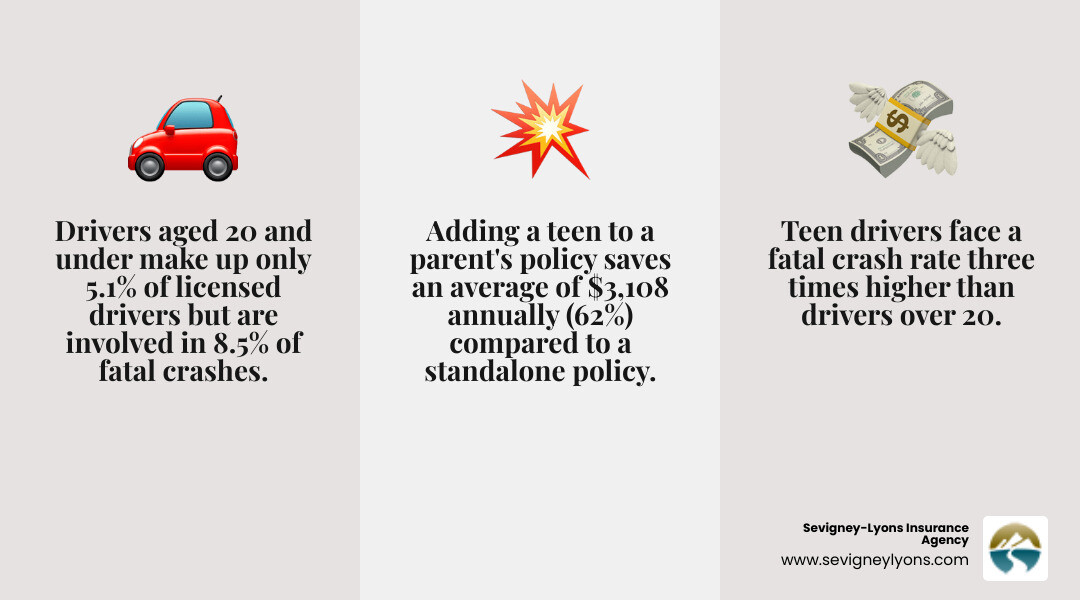
- Add to Parent's Policy - Saves an average of $3,108 annually (62% savings) compared to standalone coverage
- Independent Agency Comparison - We evaluate multiple top-rated carriers to find monthly averages as low as $245 for family policies
- Safety & Good Student Discounts - Can reduce premiums by up to 25% for eligible Maine students
- Rate Lock & Accident Forgiveness - Specialized policy features that help stabilize costs for new drivers
What to Expect: Adding a 16-year-old to your existing policy can increase your annual premium from around $2,671 to $5,910. An 18-year-old buying their own policy pays an average of $7,611 per year—nearly $2,000 more than staying on a parent's plan. According to the National Highway Traffic Safety Administration (NHTSA), teen drivers are at a higher risk of crashes, which is why these costs are so high.
The numbers tell a sobering story. In 2021, drivers aged 20 and under made up only 5.1% of licensed drivers but were involved in 8.5% of fatal crashes and 12.6% of all crashes. Teen drivers face a fatal crash rate three times higher than drivers over 20.
These statistics directly impact your insurance costs. But there's good news: multiple strategies can reduce premiums by 20-30% through smart coverage choices, discount programs, and proper policy structuring.
Whether you're in Wells, Kennebunk, Ogunquit, or Biddeford, Maine families face unique considerations—from winter driving conditions to rural road risks. This guide breaks down exactly what you need to know to protect your teen driver while managing costs effectively.
Why Coverage Costs More for Young Drivers in Maine
We know, it feels like just yesterday they were in diapers, and now they're asking for the car keys! The transition to a licensed driver is a thrilling milestone for teens and a nerve-wracking one for parents, especially when it comes to insurance costs. So, why is car insurance so expensive for teen drivers? The answer, unfortunately, boils down to statistics and risk.
Insurance companies are in the business of assessing risk, and young, inexperienced drivers are statistically the riskiest group on the road. Scientific research on teen driver risk factors highlights several key reasons for this:
- Higher Accident Rates: The fatal crash rate per mile for drivers between 16 and 19 is three times higher than for drivers over the age of 20. In fact, drivers aged 16 to 19 are more likely to cause an accident than any other age demographic.
- Lack of Experience: Newly licensed teenagers often need more driving time to learn to anticipate and avoid hazards. Their judgment skills, particularly in high-pressure situations, are still developing. The prefrontal cortex, responsible for self-control and delayed gratification, matures until around age 25, impacting adolescent decision-making.
- Distracted Driving: Teens are more prone to distractions from passengers or mobile devices.
- Night Driving: The risk of accidents increases significantly during nighttime hours, which is often when teens are driving.
- Maine-Specific Challenges: Driving in Maine presents its own unique set of challenges. Our unpredictable weather, from icy winter roads in Wells and Kennebunk to dense fog along the coast in Ogunquit and Biddeford, demands experienced judgment. Rural roads can also be less forgiving, with wildlife crossings and varying speed limits adding to the complexity. These conditions amplify the inherent risks associated with inexperienced drivers.
The Insurance Institute for Highway Safety (IIHS) provides extensive data on these risks, highlighting why insurers view young drivers as a significant liability. This isn't to say your teen isn't a responsible individual, but the industry operates on broad statistical averages. As a result, teen drivers pay triple what a 50-year-old pays for full coverage car insurance.
Choosing the Best Auto Insurance for Teenage Drivers: Policy Options
One of the first big decisions you'll face is whether your teen driver should have their own insurance policy or be added to a parent's existing policy. For most families, adding a teen to an existing policy is overwhelmingly the more economical choice, and often the only legal option for minors.
Our research shows that including a teenager on a family insurance policy can save you an average of $3,108 per year, which translates to a whopping 62% savings compared to them having their own policy. For instance, an 18-year-old male might pay an average of $7,611 for their own policy, but only $5,910 if added to a parent's full coverage plan. That's a significant difference that can impact your family budget.
Minors (under 18) cannot legally sign contracts, including insurance policies, so they typically must be added to a parent or guardian's policy. Even for those 18 and older, remaining on a parent's policy is usually far cheaper, as long as they reside at the same address. This also helps them establish a history of insurance coverage, which can lead to lower premiums when they eventually get their own policy.
For more detailed information on insuring young drivers in our state, explore our guide on Maine car insurance for young adults.
Here's a quick comparison of average full coverage premiums:
| Policy Type | Annual Premium (Average) | Monthly Premium (Average) |
|---|---|---|
| Teen on Own Policy | $7,611 | $634 |
| Teen on Parent's Policy | $5,910 | $492 |
| Preferred Carrier A (Family) | $3,014 | $251 |
| Preferred Carrier B (Family) | $2,943 | $245 |
| Preferred Carrier C (Family) | $3,390 | $283 |
Note: These are average costs. Your actual rates in Wells, Kennebunk, Ogunquit, or Biddeford may vary based on specific factors.
The goal is to protect your teen and your family financially. For more insights into how to best set up coverage for young drivers, we invite you to read our article on Maine auto insurance for young drivers.
Comparing the best auto insurance for teenage drivers on Family Policies
When adding your teen to your existing policy, it's not just about saving money; it's also about how your policy is structured. All licensed drivers in your household should be listed on your auto insurance policy. Our local independent agents in Southern Maine can help you steer this process seamlessly.
Many insurers will assume the teen is an occasional operator, sharing driving duties with others in the household. However, if your teen becomes the primary driver of a specific vehicle, your rates will reflect that increased risk. This is where multi-car discounts can become a lifesaver. If you have multiple vehicles insured with the same carrier, adding a teen might still lead to an increase, but the overall cost per vehicle could be lower than if you had separate policies.
It’s also important to understand Maine car insurance laws regarding who needs to be listed on a policy. Generally, anyone living in your household who has access to your vehicles and holds a driver's license must be listed.
Selecting the best auto insurance for teenage drivers based on Vehicle Choice
The type of car your teen drives plays a significant role in determining your insurance premiums. While it might be tempting to buy an older, less expensive car for a new driver, this isn't always the cheapest option for insurance. Here's why:
- Safety Ratings: Newer vehicles often have advanced safety features (like automatic emergency braking, lane-keeping assist, and multiple airbags) that can reduce the likelihood and severity of accidents. Insurers often reward these features with lower premiums.
- Collision Costs: An older car might be cheaper to replace, but if it lacks modern safety features, the risk of injury to occupants or damage to other vehicles might be higher, which drives up liability and medical payments costs. Conversely, if an older car is only worth a few thousand dollars, you might consider dropping collision and comprehensive coverage to save money, but then you'd be responsible for repairs or replacement if your teen crashes it.
- Vehicle Type: Sports cars or high-performance vehicles are almost always more expensive to insure for teens due to their higher perceived risk. A safe, reliable sedan or SUV with good safety ratings is usually the most cost-effective choice.
Understanding Maine comprehensive car insurance rates can help you make an informed decision about your teen's car. Choosing a vehicle with a strong safety record can help keep your rates manageable while also providing peace of mind.
Essential Coverage Types for Maine Families
When it comes to insuring your teen driver, skimping on coverage is not a wise move. While the goal is to find affordable rates, ensuring adequate protection for your family and assets should be paramount. Here are the most important types of coverage we recommend for Maine families with teen drivers:
- Liability Coverage: This is the foundation of any auto insurance policy and is legally required in Maine. It pays for damages to another person's property and/or injuries if your teen is at fault for an accident. We strongly recommend higher liability limits than the state minimums, such as 100/300/100 ($100,000 for bodily injury per person, $300,000 for bodily injury per accident, and $100,000 for property damage). Given the increased likelihood of accidents with inexperienced drivers, higher limits provide crucial protection for your financial future. For a deeper dive, check out our guide on the best auto insurance coverage in Maine.
- Collision Coverage: This pays for damage to your vehicle if it collides with another car or object, regardless of who is at fault. For a teen driver, collision coverage is almost a necessity, as their inexperience makes them more prone to single-vehicle accidents or fender-benders.
- Comprehensive Coverage: This covers damage to your vehicle from non-collision events like theft, vandalism, fire, natural disasters, or hitting an animal (a common occurrence in rural Maine!). If your teen's car is financed or leased, collision and comprehensive coverage are typically mandatory.
- Uninsured/Underinsured Motorist (UM/UIM) Coverage: This is vital in Maine. It protects you if your teen is involved in an accident with a driver who has no insurance or not enough insurance to cover the damages.
- Medical Payments (MedPay) or Personal Injury Protection (PIP): These cover medical expenses for you and your passengers, regardless of fault. This can be invaluable after an accident, helping to cover deductibles or expenses not covered by health insurance.
- Umbrella Policies: If you have significant assets, an umbrella policy provides an extra layer of liability protection above and beyond your auto and home insurance limits. Considering the higher risk associated with teen drivers, an umbrella policy can offer immense peace of mind.
For a thorough understanding of these protections, especially the benefits of combining them, we recommend reading our article on full coverage auto insurance Maine. Our agents can help you tailor the perfect combination for your family in Wells, Kennebunk, Ogunquit, or Biddeford.
How to Find the best auto insurance for teenage drivers at a Lower Rate
Finding the best auto insurance for teenage drivers doesn't mean breaking the bank. There are several smart strategies you can employ to lower your premiums, even with a new driver in the household.
- Good Student Discount: This is one of the most popular and effective discounts for teens. Many insurers offer significant savings—sometimes as high as 25%—for students who maintain a B average (3.0 GPA) or higher. Your teen's most recent report card could be the key to lowering your premium! Even home-schooled students may qualify by submitting evidence of standardized test scores.
- Driver Education/Training Discount: Enrolling your teen in an approved driver education course or defensive driving program can often lead to a discount. These courses not only teach valuable safe driving skills but also signal to insurers that your teen is committed to responsible driving.
- Telematics Programs (Usage-Based Insurance): Many providers now offer programs that use a mobile app or a device plugged into your car to monitor driving habits like braking, acceleration, mileage, and even phone usage. If your teen demonstrates safe driving, you could earn a discount. Some policyholders using telematics devices have saved a median of $120 on annual premiums. These programs can also provide valuable feedback and scorecards for teens to improve their habits.
- Higher Deductibles: If you can afford to pay a larger amount out-of-pocket in the event of a claim, increasing your deductible can lower your monthly premium. Just be sure you have the funds readily available for that deductible.
- Bundling Policies: Insuring your home and auto policies with the same carrier often results in a multi-policy discount. This is a simple way to save money across your entire insurance portfolio.
- Student Away at School Discount: If your teen goes away to college more than 100 miles from home and leaves their car behind, you might qualify for a discount.
- Choose a Safe Car: As we discussed earlier, the right car can significantly impact rates. Opt for a vehicle with strong safety ratings and avoid sports cars.
Our agency works with multiple carriers, allowing us to compare various options and find the inexpensive car insurance for teenage drivers that fits your budget and needs.
When Rates Decrease and How to Maintain Savings
The good news is that those initially high insurance rates for your teen won't last forever. Car insurance rates typically start to decrease as young drivers gain experience and demonstrate responsible habits.
- Age Milestones: Premiums often see noticeable drops at specific age points. Our data shows premiums can decrease by:
- 16 percent at age 19
- 17 percent at age 21
- 11 percent at age 25This is because insurers view these ages as indicators of increased maturity and driving experience.
- Driving Record Impact: A clean driving record is your teen's best friend when it comes to insurance costs. Every ticket, accident, or violation can significantly increase premiums and delay the rate reductions that come with age. An at-fault accident can raise premiums by around 50 percent! Conversely, maintaining a violation-free record for several years is rewarded with lower rates.
- Accident Forgiveness: Some insurers offer accident forgiveness programs, which can prevent your rates from increasing after your teen's first at-fault accident. This can be a valuable feature for new drivers, offering a buffer against rate hikes.
- Continuous Coverage: Maintaining continuous insurance coverage helps establish a positive insurance history, which can lead to better rates in the long run.
For more information on how rates evolve for young drivers, particularly in Maine, take a look at our article on car insurance for those under 30. Regular policy reviews with our independent agents can also ensure you're always getting the best possible rates as your teen matures and their driving profile changes. Learn more about the benefits of an auto insurance policy review Maine.
Frequently Asked Questions about Teen Insurance
Does my teen need insurance with a learner's permit?
Most Maine insurers only require you to add a driver when they get their license, not their learner's permit. While a teen's learner's permit will likely have little impact on premiums because of the required adult supervision, it's still important to inform your agent before a teen gets their preliminary permit. This ensures everyone is properly accounted for and covered, even if it doesn't immediately change your rates.
Can I exclude my teen driver from my policy?
It's possible to ask your insurance company not to cover your teen driver, but not all companies will allow it, and it comes with significant risks. This is called a "named exclusion," and it means your teen cannot drive any of your insured vehicles at all. If they were to drive a car and get into an accident, there would be no coverage, leaving you personally liable for all damages and injuries. Not all companies allow this, and not all states do either. Given the potential for serious financial consequences, we generally advise against excluding a teen driver if they have any access to your vehicles.
How much does it cost to add a teen to a parent's plan?
The average cost to add a teen to a parent's plan is about $151 more per month, or around $1,800 per year. However, this figure can vary widely based on factors such as the teen's age, gender, driving record, the type of vehicle they drive, your location in Maine (Wells, Kennebunk, Ogunquit, Biddeford), and the specific insurance carrier. While it is an increase, it's typically much less expensive than a standalone policy for a teen, which can average $410 per month or more.
Conclusion
Navigating auto insurance with a new teen driver can feel overwhelming, but it doesn't have to be. At Sevigney-Lyons Insurance Agency, we understand the unique challenges and concerns facing families in Southern Maine, from Wells to Kennebunk, Ogunquit, and Biddeford. Our deep community roots and decades of experience mean we're not just selling policies; we're providing custom insurance solutions that protect what matters most to you.
As an independent agency, we have access to over 20 top carriers, allowing us to compare options and find the best auto insurance for teenage drivers that balances comprehensive coverage with affordable rates. We'll work with you to explore all available discounts, structure your policy smartly, and ensure your teen is safely and properly insured on Maine's roads.
Don't let the complexities of teen auto insurance keep you up at night. Let us help you make smart choices for your family.
Get a quote for the best auto insurance coverage in Maine today, or contact us to speak with one of our experienced agents. We're here to help you every step of the way.