

Blog Content
Why Your Experience Mod Workers Comp Score Matters for Your Maine Business
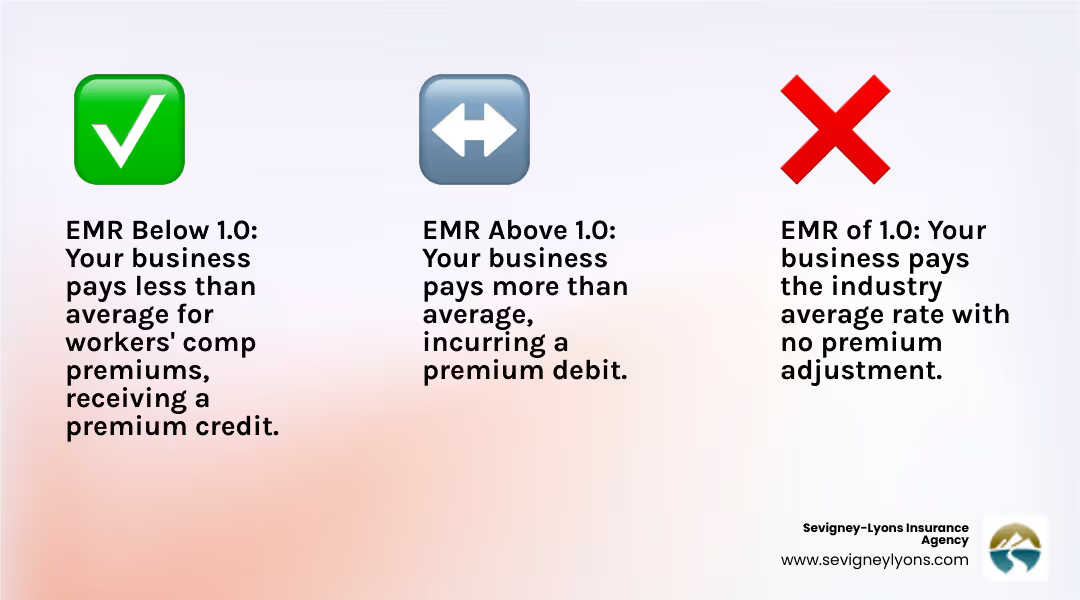
Experience mod workers comp is a numerical rating that directly impacts your workers' compensation insurance premium. A score below 1.0 means you pay less than average (a credit), while a score above 1.0 means you pay more (a debit). A 1.0 is the industry average.
Your experience modification rate (EMR) compares your business's claims history to the expected performance of similar companies in your industry. Think of it as a credit score for workplace safety—a better score means lower costs.
For any business in Wells, Kennebunk, Ogunquit, Biddeford, or elsewhere in Maine, understanding your EMR is crucial. It's a reflection of your safety record that can save you thousands of dollars.
The good news is that your EMR is something you can actively control. Every safety meeting, managed claim, and prevented injury helps improve this number.
Maine businesses face unique challenges like harsh winters and seasonal workforces, making workplace safety even more critical. A single preventable injury doesn't just harm an employee; it impacts your EMR for three years, affecting your bottom line long after the claim is closed.
What is an Experience Modification Rate (EMR) and How Does it Work?
Your Experience Modification Rate (EMR)—also called an experience mod or E-Mod—is your business's safety report card. It compares your actual workers' compensation claims to what's expected for a business of your size and industry. Like a credit score, it measures performance, but for workplace safety.
This number directly impacts your insurance premium. An EMR of 1.0 is the industry average. Below 1.0 earns you a discount (a credit mod), while above 1.0 results in a surcharge (a debit mod).
New businesses in Maine start with an EMR of 1.0. You're considered average risk until you build enough history—typically three years—for the rating bureau to calculate a unique score. Focusing on safety from day one is key to earning better rates. Our team at Sevigney-Lyons can explain how your experience mod workers comp rating affects your Workers Compensation Insurance Maine premiums.
The experience period used to calculate your mod looks back at several years of data, which we'll cover below.

Understanding Your EMR Score
Your EMR score is a direct reflection of your safety performance and its financial consequences.
- EMR of 1.0: You pay the baseline premium for your industry. No more, no less.
- EMR below 1.0: A score of 0.85 means you've had fewer or less severe claims than expected. You're rewarded with a credit mod—a 15% discount on your premium. For many Maine businesses, this can mean thousands in annual savings.
- EMR above 1.0: A score of 1.15 means your claims history is worse than average. You'll pay a 15% surcharge. Beyond the premium impact, a high EMR can hurt your ability to win contracts that require proof of a good safety record.
Your EMR is a safety performance indicator that speaks in dollars and cents.
The Role of NCCI in Maine
The National Council on Compensation Insurance (NCCI) is the organization that handles experience rating calculations for most states. However, Maine has its own state rating bureau that oversees how EMRs are calculated and applied locally.
While the data collection and formula administration follow NCCI principles, they are custom to Maine's specific economic and regulatory landscape. The core concepts—comparing actual losses to expected losses over a three-year period—are the same. Understanding Maine's specific rules is where local expertise from an agent at Sevigney-Lyons makes a difference.
How Long Claims Affect Your Rate
A common question from business owners in Wells and Kennebunk is, "How long will this claim affect my rates?" The answer is three years.
Your EMR is calculated using a three-year rating period that has a built-in lag period. It doesn't include the most recent policy year. For example, a 2025 policy renewal will use claims data from roughly 2021, 2022, and 2023. The oldest year of data drops off each year, and a new one is added, creating a rolling average.
This historical data impact means a single bad incident at your Biddeford shop can affect your premium for three full rating cycles. The good news is that after three years, the claim no longer factors into your EMR calculation. This is why businesses that consistently improve their safety programs see their EMRs steadily decline over time.
The Nuts and Bolts: How Your Experience Mod is Calculated
While the formula for your experience mod workers comp rate has several parts, the concept is simple. It compares your actual claim costs to what's expected for a business like yours.
The basic formula is: Experience Modification = Actual Losses / Expected Losses.
If your actual losses are lower than expected, your EMR drops below 1.0, and you save money. If they are higher, your EMR rises above 1.0, and you pay more. The calculation also considers payroll data, industry classification codes, and, most importantly, both the frequency (number of claims) and severity (cost of claims) of your incidents.
Frequency often has a greater impact than severity. A small medical-only claim does not affect your EMR nearly as much as a claim involving lost work time, as shown below.
Note: Premium impact figures are illustrative and not specific to any company.
This difference of over $12,000 highlights why getting employees back to work quickly, even on modified duty, is so financially important for your business in Wells, Kennebunk, or anywhere in Maine.
Actual Losses vs. Expected Losses
Actual losses are the real dollars your insurer has paid (or expects to pay) for your claims. This includes medical costs and indemnity payments for lost wages.
Expected losses are the industry benchmark for a business of your size and type. They are what the rating bureau predicts your claims should be. A Biddeford construction company will have higher expected losses than an Ogunquit retail shop because the work carries more inherent risk. This system ensures you are measured fairly against businesses facing similar challenges.
Primary, Excess, and the 'Split Point'
Not all claim dollars are weighted equally. Claims are divided into primary losses and excess losses at a designated split point.
Primary losses are the first portion of a claim up to the split point (e.g., the first $10,000). They are fully weighted in the EMR formula because they reflect claim frequency. The system views many small claims as a stronger predictor of future risk than one large, unusual claim.
Excess losses are the portion of a claim above the split point. They are weighted less heavily. This weighting of frequency over severity means a business with consistent safety issues is seen as a greater risk than one with a single, expensive but rare incident.
How Different Claim Types Affect the Calculation
Understanding how different claims impact your EMR helps with injury management.
- Medical-only claims: When an injury requires medical care but no lost work time, the Experience Rating Adjustment (ERA) reduces its impact. Typically, only 30% of the claim's cost counts toward your EMR calculation. This encourages prompt reporting and medical care.
- Lost-time claims: When an employee misses work beyond the state's waiting period, the claim usually impacts your EMR at 100% of its cost. These claims indicate a more severe incident and are far more costly to your bottom line, which is why return-to-work programs are so valuable.
- Death claims: To prevent one tragic incident from destroying a business's EMR, the rating system often substitutes an average fatal claim cost instead of the actual cost.
- Subrogated claims: If your insurer recovers costs from a responsible third party, those recovered amounts can reduce the claim's impact on your EMR.
How you manage claims from day one—with prompt reporting, immediate care, and a focus on returning employees to work—can dramatically reduce the long-term impact on your experience mod workers comp rate.
Managing Your Maine Business's Experience Mod Workers Compensation Insurance Rate
Your experience mod workers comp rate is not set in stone; it's a number you can actively manage and improve. For business owners in Biddeford, Kennebunk, Wells, or Ogunquit, taking control of your EMR means real dollars back in your pocket. Every safety meeting, eliminated hazard, and quick return to work directly impacts your bottom line.

Implement a Proactive Safety Program
The best way to manage your EMR is to prevent injuries. A proactive approach includes:
- Accident Investigations: Analyze all incidents and near-misses to find the root cause and prevent recurrence.
- Employee Training: Conduct regular, job-specific training so workers understand the 'why' behind safety rules.
- Hazard Identification: Routinely inspect your workplace for hazards and fix them promptly. OSHA offers free resources to help.
- Building a Safety Culture: Create an environment where everyone feels responsible for safety and is comfortable reporting concerns. This protects your people and your Business Liability Insurance Maine Cost.
Master Claims Management and Return-to-Work Programs
When an accident happens, your response is critical. Report claims immediately. Delays can increase costs and complicate recovery.
A strong return-to-work program is your secret weapon. Allowing injured employees to return to modified or light-duty tasks keeps them engaged and speeds up recovery. Most importantly, it reduces or eliminates indemnity payments for lost wages—a major driver of claim costs. This is a win for both your employee and your EMR.
Stay involved in the claims process by communicating with your insurer and the injured employee. This hands-on approach helps control costs and improves your Business Insurance for a Maine LLC costs and workplace morale.
Leverage Innovative Safety Resources for your Experience Mod Workers Comp
Modern safety resources can give your Maine business an edge. Consider these strategies:
- Ergonomic surveys: Prevent costly strain injuries by fitting the job to the worker.
- Fleet safety training: Reduce expensive vehicle accidents with telematics and driver training.
- Wellness programs: Healthy employees are less likely to get injured and recover faster.
- Pre-work screening: Ensure new hires for physical jobs can perform tasks safely.
Investing in safety doesn't just lower your experience mod workers comp rate; it improves your entire risk profile, affecting everything from your Commercial Property Insurance Guide to your profitability.
Special Circumstances: EMR Revisions, Ownership Changes, and More
While your experience mod workers comp rate is based on claims history, certain events can trigger revisions or require special handling. Understanding these is key for accurate premiums.

When and Why Your Experience Mod Workers Comp Rate Can Be Revised
Your EMR isn't always final. It can be revised for several reasons:
- Claim Status Changes: A claim may be deemed non-work-related, or your insurer might recover costs from a third party through subrogation. These changes can lead to a recalculation.
- Clerical Errors: Mistakes in payroll figures, job classifications, or claim data can inflate your EMR. It's always worth reviewing your experience mod worksheet for accuracy.
- Payroll Reclassification: If your business operations change, such as a Biddeford manufacturer adding a sales team, employee classifications may need updating, which can affect your EMR.
If something seems wrong with your mod, you have the right to dispute it. We can help you steer that process.
How a Change in Business Ownership Affects Your EMR
Buying, selling, or merging a business in Maine has important implications for your EMR. The claims history of a predecessor business often transfers to the successor to prevent companies from restructuring to escape a poor safety record.
The key factor is the 50% common ownership rule. If two or more entities in Maine share over 50% common majority ownership, their workers' comp experience may be combined into a single EMR. For example, if your Kennebunk company with a 1.25 EMR acquires a Wells business with a 0.90 EMR, their histories will be combined going forward.
You must notify your carrier within 90 days of any ownership change and complete an ERM-14 form (or Maine's equivalent). This is essential for correct EMR calculation. When you Buy Maine Business Insurance, we ensure these transitions are handled smoothly.
The Benefits of an Experience Rating System
The EMR system may seem complex, but it's designed to be fair and promote safety. Its primary benefit is fairness in pricing. It tailors your premium to your individual safety performance, rather than just your industry. A safe Biddeford contractor shouldn't pay the same rate as one with a history of injuries.
This creates a powerful financial incentive for safety. Every accident you prevent protects your bottom line for three years, making safety a clear financial priority. The system rewards safe employers with lower costs and holds businesses accountable for their own safety records, encouraging risk management across Maine.
Frequently Asked Questions about Experience Mods in Maine
We've helped countless Maine business owners steer their experience mod workers comp rates. Here are answers to the most common questions.
How long does a workers' comp claim affect my EMR in Maine?
A claim typically impacts your EMR for three calendar years. The calculation uses a three-year "experience period" that excludes the most recent policy year. For example, a 2025 policy renewal would likely use claims data from 2021-2023. An incident today won't appear on your EMR immediately, but once it does, it will remain for three rating cycles. This is why long-term safety planning is so important.
My business is new. What will my experience mod be?
New businesses in Maine start with a clean slate: an EMR of 1.0, or a "unity mod." This is the industry average, meaning you aren't penalized or rewarded until you have your own claims history. Once you hire your first employee, you'll need workers' comp insurance, and your premium will be based on your industry and payroll, with no experience-based surcharge or discount. This gives you the opportunity to build a strong safety record from day one. We can help you understand your Workers Compensation Insurance Maine needs from the start.
Can I get my EMR below 1.0 even if I have a claim?
Yes, absolutely! Having a claim doesn't automatically mean you'll pay more. Your EMR is about being better than average, not perfect.
Your EMR compares your actual losses to your expected losses, which are based on the average for your industry. If your actual losses, even with a claim, are still lower than what's expected, you can achieve an EMR below 1.0 and earn a premium credit.
For example, a Biddeford construction company is expected to have some level of claims activity. If you have one minor, well-managed claim while your competitors have multiple severe incidents, your EMR will reflect that you are a better-than-average risk. Effective claims management, including strong return-to-work programs, is key to keeping claim costs down and maintaining a favorable EMR.
Conclusion
Your experience mod workers comp rate is more than just a number on an invoice—it's a powerful tool for controlling your insurance costs. For business owners in Biddeford, Kennebunk, Wells, and Ogunquit, managing your EMR can save you thousands of dollars each year.
Your EMR is controllable. It responds directly to your actions. Every safety meeting, eliminated hazard, and employee you help return to work safely contributes to a better score and lower premiums. The system is designed to be fair, rewarding businesses that invest in safety with real financial benefits.
At Sevigney-Lyons Insurance Agency, we've spent decades helping Maine businesses steer these challenges. We're not just here to sell you a policy; we're your partner in building a safer, more profitable business.
Ready to take control of your workers' compensation costs? Get a free quote for your commercial insurance needs with Sevigney-Lyons today, and let's work together to build a safer future for your Maine business.


