Blog Content
When Your Driving Record Makes Insurance Feel Out of Reach
High risk auto insurance is coverage designed for drivers who are considered more likely to file a claim — and if you're in that category right now, you're not alone.
Here's a quick breakdown of what you need to know:
Being labeled a high-risk driver can feel discouraging, especially when you're already managing a busy life in Southern Maine. Whether you live in Biddeford, Wells, or anywhere else along the coast, the higher premiums that come with a less-than-perfect record can put real pressure on your budget.
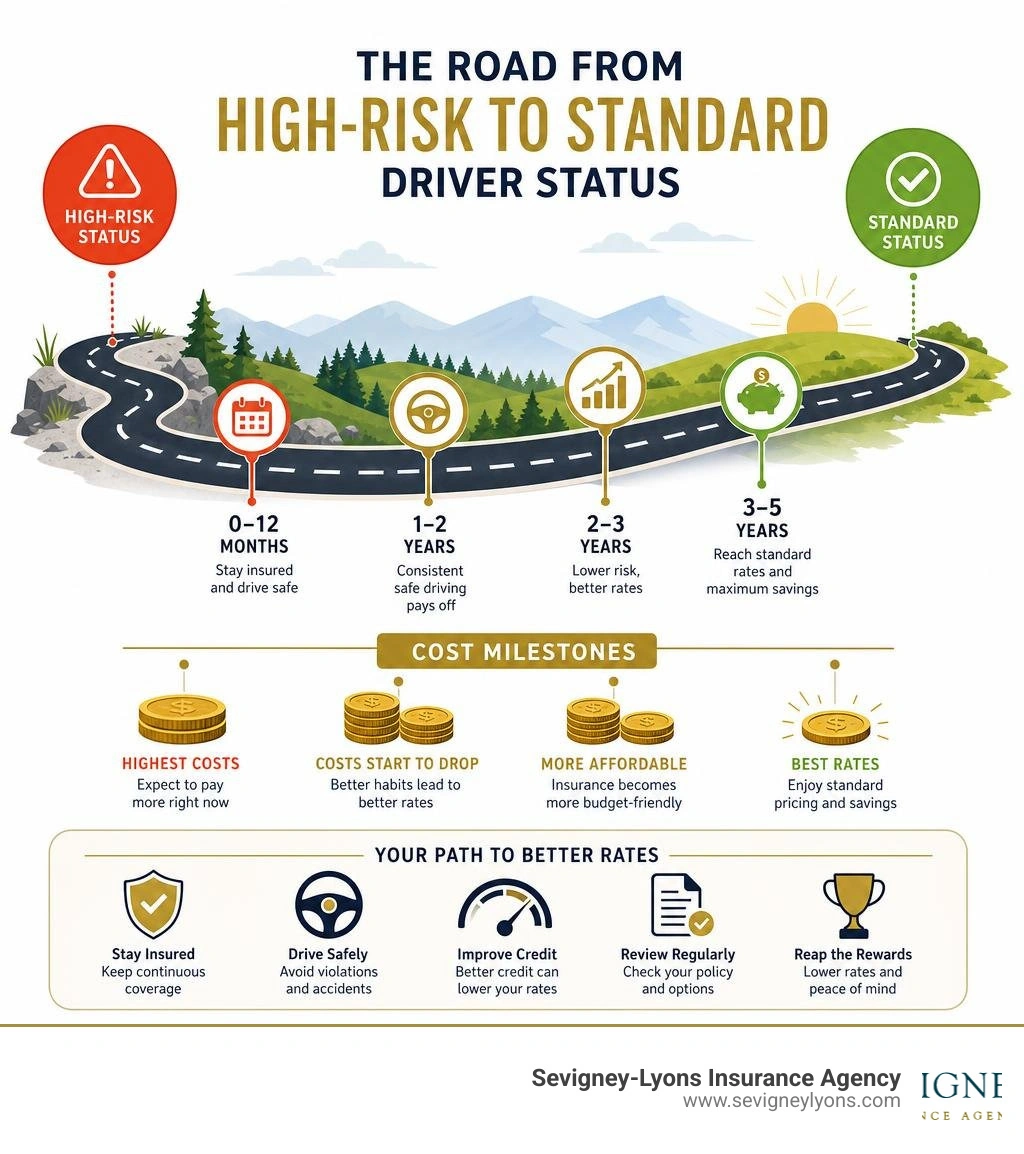
But here's the thing: high-risk status is not permanent. Most drivers can work their way back to standard rates over time — and the right insurance agency can help you find affordable coverage while you do.
Quick High risk auto insurance terms:
What is High Risk Auto Insurance and Who Needs It?

To understand high risk auto insurance, it helps to realize that "high-risk" isn't a specific, separate policy type you buy off the shelf. Instead, it is a risk classification that insurance companies apply to certain drivers during their underwriting process. When a carrier designates you as high-risk, they determine that you have a higher statistical probability of filing a claim, getting into an accident, or letting your policy lapse.
To offset this anticipated risk, insurance companies charge higher premiums or, in some cases, deny coverage altogether under standard programs. This is where non-standard insurance comes into play. Non-standard policies offer the exact same fundamental protections—such as bodily injury liability, property damage liability, collision, and comprehensive coverages—but they are priced and structured specifically for drivers with imperfect records.
Every insurance company uses its own proprietary algorithm to assess risk, meaning there is no universal definition of a high-risk driver. One carrier might look at a single minor speeding ticket and keep you in their preferred tier, while another might bump you to a standard or non-standard tier. However, the regulatory framework governing these decisions is rooted in Maine Car Insurance Laws and overseen by the Maine Bureau of Insurance.
State guidelines ensure that while carriers have the freedom to price risk accordingly, they must do so fairly and transparently. For a deep dive into how these rules apply directly to local drivers, you can read our comprehensive guide on Auto Insurance for High Risk Drivers in Maine.
Factors That Classify You as a High-Risk Driver
Insurance companies evaluate dozens of data points when calculating your premium, but several major red flags will almost immediately land you in the high-risk category:
- DUI/OUI Convictions: Operating under the influence is considered one of the most severe traffic violations. A single conviction will dramatically increase your rates and require specialized filings.
- Multiple Traffic Violations: Accumulating several speeding tickets, reckless driving charges, or failure-to-yield citations within a short window (typically three to five years) indicates a pattern of risky behavior.
- At-Fault Accidents: Causing a collision suggests to insurers that your driving habits may be unsafe, leading to immediate premium surcharges.
- Lapses in Insurance Coverage: Driving uninsured, even for a short period, is a major red flag. Insurers view a gap in coverage as a sign of financial instability or irresponsible behavior, which makes you a higher risk when you apply for a new policy.
- Poor Credit History: In Maine, insurers are legally permitted to use credit-based insurance scores to help determine auto insurance premiums. A lower credit score is statistically correlated with a higher likelihood of filing claims.
- Age and Lack of Experience: Teenagers and newly licensed drivers lack the split-second decision-making skills that come with years behind the wheel. Because of this, younger drivers face some of the highest baseline rates in the state. To learn more about managing these unique costs, check out our resource on Maine Auto Insurance for Young Drivers.
How Long Does the High Risk Auto Insurance Designation Last?
Fortunately, being labeled a high-risk driver is not a life sentence. Your driving record is a living document, and older violations carry less weight over time.
In Maine, minor traffic violations like speeding or rolling through a stop sign typically impact your insurance rates for three to five years. At-fault accidents generally influence your premiums for up to five years. Once you cross these time milestones without committing any new infractions, carriers will naturally begin to lower your rates, and more standard companies will become willing to offer you competitive quotes.
The state of Maine also utilizes a point system administered by the Bureau of Motor Vehicles (BMV). When you commit a traffic violation, points are added to your license. If you accumulate 12 or more points within a 12-month period, your license will be suspended.
However, points naturally drop off your active BMV record one year from the conviction date. While insurance companies look at the violations themselves (which stay visible on your motor vehicle record for longer than the BMV points remain active), keeping your license free of active points is a critical step toward returning to standard driver status.
The Cost of High-Risk Coverage in Maine
It is no secret that high-risk coverage costs more than standard insurance. But seeing the actual numbers can help you budget and understand exactly what is driving your premium.
According to industry data as of June 2026, a single at-fault accident increases average full coverage premiums by 43%, jumping from a national average of $2,692 to $3,862 annually. If you are convicted of a DUI, that average full coverage premium nearly doubles to $5,287 per year.
For younger drivers in Maine, the impact of these incidents can be felt even more acutely. However, because Maine generally boasts lower average insurance rates than the rest of the country, local high-risk drivers often pay less than the national average.
For example, a 25-year-old Maine driver with an at-fault accident might pay around $677 annually for minimum coverage, while a DUI conviction averages around $680 for minimum coverage. If that same driver has poor credit, the average minimum coverage rate rises to approximately $776.
To protect your assets on the road, you will want to weigh the differences between liability-only coverage and full coverage. Liability-only coverage meets the state's minimum legal limits but does not pay for damage to your own vehicle.
If you want comprehensive and collision protection to cover theft, weather damage, or physical damage from an accident, you will need a full coverage policy. You can read more about how these options work in our guides on Full Coverage Auto Insurance Maine and Maine Full Coverage Auto Insurance Rates.
Below is a comparison table illustrating how different driving incidents and risk factors impact annual premium averages:
Understanding SR-22 Requirements in Maine
If your license has been suspended or revoked due to a serious violation—such as an OUI, reckless driving, or driving without insurance—the Maine Bureau of Motor Vehicles will require you to file an SR-22 form before your driving privileges can be reinstated.
Many people mistakenly believe that an SR-22 is a type of insurance policy. In reality, an SR-22 is simply a form filed electronically by your insurance carrier directly to the Maine BMV. It serves as official proof of financial responsibility, guaranteeing to the state that you carry at least the minimum mandatory liability insurance limits.
If you are required to maintain an SR-22, you must keep the policy active without any lapses. If your policy cancels for non-payment or any other reason, your insurance company is legally obligated to file an SR-26 form, which immediately alerts the BMV and triggers a re-suspension of your driver's license.
Typically, Maine requires drivers to maintain an SR-22 filing for three consecutive years. For a comprehensive look at how to secure this filing alongside physical damage protection, read our specialized guide on SR22 Insurance Full Coverage in Maine.
How Credit Scores and Payment History Impact High Risk Auto Insurance
In Maine, your financial track record is closely tied to your auto insurance premiums. Unless you live in one of the few states that ban the practice (such as California or Massachusetts), insurance companies utilize a "credit-based insurance score" to evaluate your risk. This score is different from your standard FICO score, though it is derived from the same credit report data.
Carriers have found a strong statistical correlation between poor credit and an increased likelihood of filing insurance claims. Consequently, a driver with poor credit can end up paying significantly more for full coverage auto insurance than a driver with excellent credit, even if both have completely clean driving records.
Additionally, a history of late payments or policy cancellations for non-payment will flag you as a high-risk client. Standard carriers may refuse to write a policy for someone with recent payment lapses, forcing them to seek coverage from specialized non-standard carriers.
As an independent insurance agency, we work with over 20 top insurance carriers, allowing us to shop around and find non-standard policies that accommodate credit challenges without charging exorbitant rates.
Actionable Steps to Lower Your Insurance Premiums

While navigating the high-risk market can be challenging, you are not powerless. There are several concrete, actionable steps you can take starting today to lower your insurance costs and begin your transition back to standard rates:
- Maintain Continuous Coverage: Avoid lapses in coverage at all costs. Even if you do not currently own a vehicle, purchasing a "non-owner" auto policy will keep your insurance history active, preventing the steep rate hikes associated with coverage gaps.
- Improve Your Credit Score: Focus on making on-time payments, reducing outstanding debt, and checking your credit report for errors. As your credit score improves, your credit-based insurance score will rise, leading to lower premiums at your next policy renewal.
- Complete a Defensive Driving Course: Taking a state-approved defensive driving class can remove active points from your license and qualify you for an immediate discount on your premium.
- Increase Your Deductibles: If you carry full coverage, raising your comprehensive and collision deductibles (for example, from $250 to $1,000) will lower your monthly premium. Just make sure you keep enough money saved in an emergency fund to cover the higher deductible if you ever need to file a claim.
- Drive a Safe, Sensible Vehicle: High-powered sports cars or complex luxury vehicles cost more to repair or replace, which drives up your insurance rates. Opting for a vehicle with excellent safety ratings and low repair costs can yield substantial savings.
By combining these strategies, you can significantly mitigate the costs of your premium. For more tips on finding economical options in Southern Maine, check out our guides on Cheap Full Coverage Maine Auto Insurance and Best Full Coverage Auto Insurance Rates.
Frequently Asked Questions About High-Risk Coverage
Navigating the complexities of non-standard auto insurance can bring up a lot of questions. Here are some of the most common concerns we hear from drivers in Southern Maine.
What should I do if standard insurers deny me coverage in Maine?
If your driving record or credit history is such that multiple standard insurance companies have denied you coverage, you still have options. First, you can work with an independent insurance agency like ours. Because we have access to niche, non-standard carriers that specialize in high-risk drivers, we can often secure coverage that direct writers cannot.
If you are still unable to find a private carrier willing to accept your risk, you can apply for coverage through the Maine Automobile Insurance Plan (AIP). The AIP is a state-mandated high-risk pool designed as a last resort. It assigns high-risk drivers to insurance companies operating in Maine in proportion to their market share. While coverage through the AIP is typically more expensive, it guarantees that every licensed driver in Maine has access to the legal minimum insurance required to stay on the road.
Does high-risk auto insurance include uninsured motorist coverage?
Yes. Under Maine law, uninsured motorist (UM) coverage is strictly mandatory for all auto insurance policies, including high-risk and non-standard policies. This essential coverage protects you, your passengers, and your vehicle if you are involved in an accident caused by a driver who does not carry liability insurance, or a hit-and-run driver.
Maine requires minimum uninsured motorist limits of $50,000 per person and $100,000 per accident. Given that high-risk drivers are statistically more likely to be involved in collisions, having this financial safety net in place is incredibly important. For a detailed breakdown of how this coverage works in our state, explore our Uninsured Motorist Coverage Maine Guide.
Are there specific discounts available for high-risk drivers?
Absolutely. Even if your baseline premium is higher due to a violation or credit history, you can still take advantage of common policy discounts to lower your out-of-pocket costs.
Most carriers offer discounts for setting up automatic payments (autopay) and enrolling in paperless billing. You can also secure discounts by bundling your auto policy with a renters or homeowners insurance policy. Additionally, installing a telematics device or using a mobile app that tracks your driving habits can earn you significant safe-driving discounts if you consistently practice safe acceleration, braking, and speed limits.
Conclusion
At Sevigney-Lyons Insurance Agency, we believe that a less-than-perfect driving record shouldn't prevent you from protecting your family and staying legally on the road. As an independent agency deeply rooted in Southern Maine—with offices in Wells, Ogunquit, Kennebunk, Biddeford, and Portland—we understand the unique needs of local drivers.
Because we aren't tied to any single insurance company, our experienced team can shop your policy across more than 20 of the country's top carriers to find the most competitive rates and flexible terms available for your situation. We are here to guide you through the process, help you manage filings like SR-22s, and work with you to establish a path back to standard premium rates.
Ready to see how much you could save? Get a Free Maine Insurance Quote today, or stop by one of our local offices to chat with an agent in person.