Blog Content
Flood Insurance in Maine: What You Need to Know Before the Next Storm
If you're looking for affordable home flood coverage in Maine, here's the short answer:
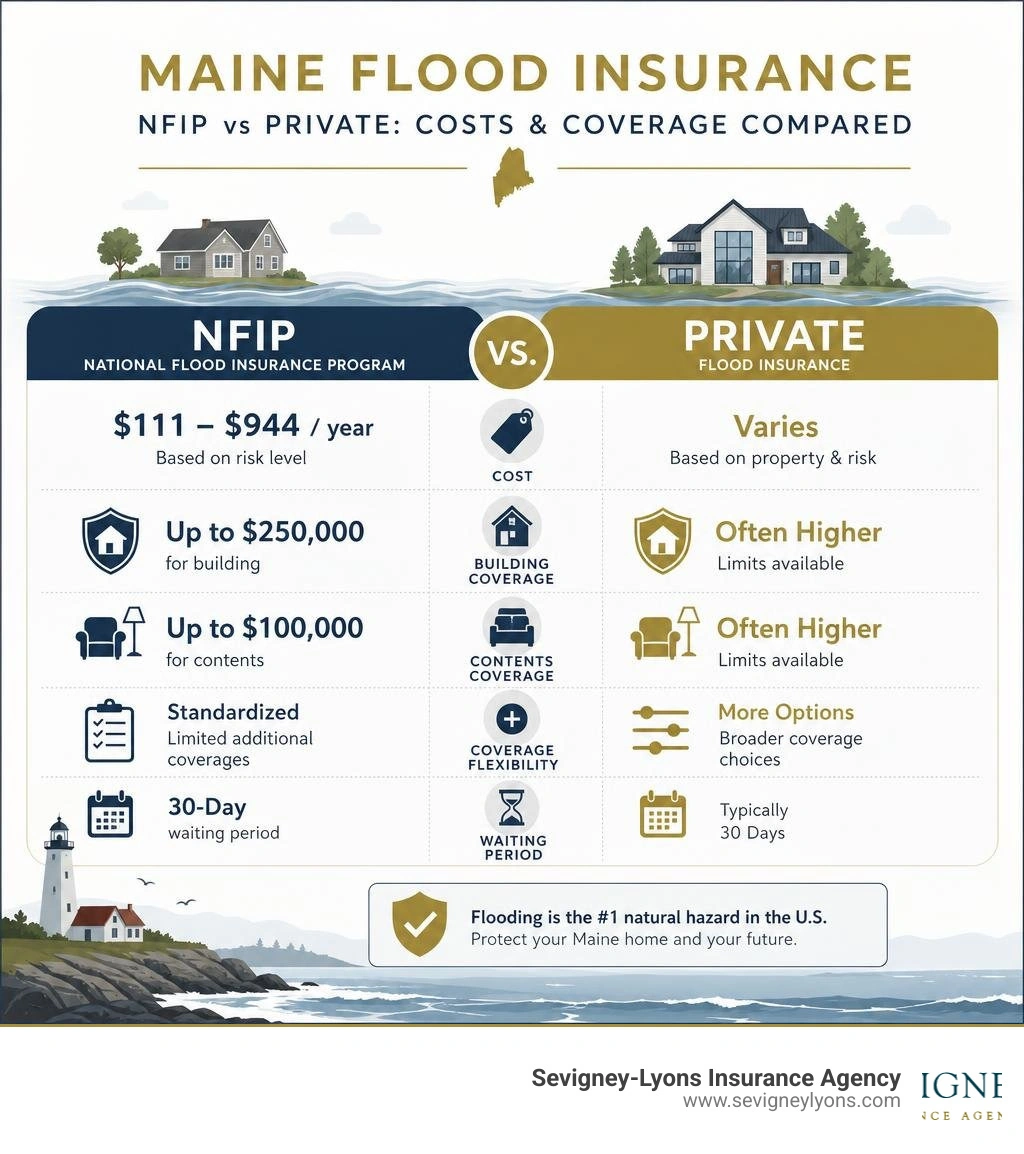
- NFIP Preferred Risk Policies start as low as $111/year for low-to-moderate risk zones
- Standard NFIP policies average around $400/year for up to $100,000 in coverage
- The statewide average is $944/year across all risk levels
- You can shop both NFIP and private market options to find the best rate for your property
- There is a 30-day waiting period — so don't wait until a storm is coming
Most Maine homeowners assume their home insurance has them covered. It doesn't — not for floods.
Flooding is the #1 natural hazard in the United States, and standard homeowners policies almost never cover it. Yet an estimated 75% of homes and businesses in Maine's floodplains have no flood insurance at all. That's a massive gap, and it leaves tens of thousands of families one bad storm away from financial disaster.
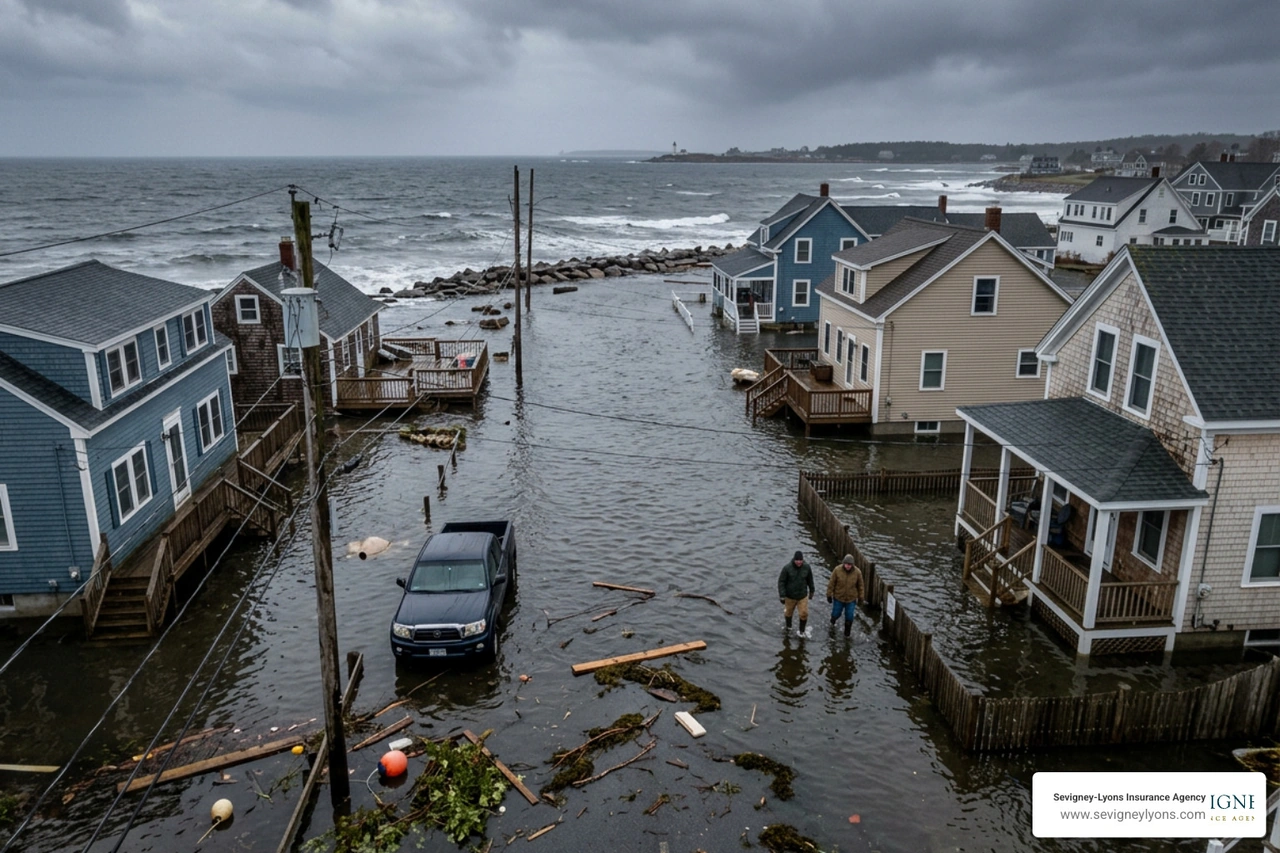
Maine's flood risks are real and varied. Coastal storms batter shoreline towns like Wells, Ogunquit, Kennebunk, and Biddeford every year. Inland, ice jams and heavy spring runoff can send rivers over their banks with little warning. Approximately 33,000 structures across the state are at risk — and many owners have no idea.
The good news? Flood coverage is often more affordable than people think. And understanding your options is the first step to protecting your home without overpaying.
Discover more about affordable home flood maine:
Why Standard Homeowners Insurance Leaves Maine Properties High and Dry
Many of us love living near the water. Whether it is the crashing waves of the Atlantic in Wells or a quiet stream winding through Kennebunk, water is central to the Maine way of life. However, when that water decides to pay an uninvited visit inside your living room, your standard home insurance policy won't be there to help you clean up.
A common misconception among homeowners is that general water damage coverage includes flood damage. As we outline in our Maine Home Insurance 2026 Guide, standard policies are designed to cover sudden and accidental internal water issues—like a burst pipe in your second-floor bathroom or a water heater failure.
They are emphatically not designed to cover water that originates from the outside ground. If a severe coastal storm forces seawater into your coastal cottage, or a heavy rainstorm causes a nearby brook to overflow, standard home insurance will leave you paying out of pocket. For a closer look at how standard coverage handles severe weather, check out our resource on Maine Home Insurance for Storm Damage.
The Legal Definition of a Flood
To understand why you need specialized coverage, it helps to understand how the insurance industry defines a "flood." In simple terms, a flood is an excess of water on land that is normally dry. To trigger a flood insurance claim, this water must cover at least two acres of land or affect two or more properties (one of which can be yours).
This surface water can come from:
- Overlow of inland or tidal waters (such as storm surges along the Southern Maine coast).
- Unusual and rapid accumulation or runoff of surface waters from any source (like heavy torrential downpours).
- Mudslides or land collapse along the shore of a body of water caused by waves or currents.
If a heavy storm causes a localized puddle to seep into your basement, but no other properties are affected and the water doesn't cover two acres, it may not meet the legal threshold. Navigating these details is why having specialized Homeowners Insurance Maine and dedicated flood protection is so critical.
Assessing the Real Risk and Cost of Flooding in Maine
It is easy to look at Maine's rugged, rocky coastline and assume our homes are naturally elevated out of harm's way. But the reality is that Maine has over 8,600 miles of floodplains, 5,779 lakes and ponds, and 5,299 miles of coastline. With approximately 33,000 structures at risk of flooding across the state, the danger is much closer than many realize.
Despite this, up to 75% of homes and businesses located within Maine floodplains are completely uninsured against flood damage. This is a staggering gamble when you consider the financial toll of water damage. Just one inch of floodwater in a medium-sized home can cause upwards of $25,000 in damage.
Flooding in Maine isn't just a coastal issue. While coastal storms regularly bring heavy storm surges to York and Cumberland counties, inland areas face severe threats from ice jams and rapid spring thaws. When winter snowpacks melt quickly alongside heavy spring rains, even small creeks can turn into raging torrents.
Consider the real-world impact highlighted in this Maine Retiree Turns to Rural Development for Help Recovering from Flash Flood | Rural Development story, which demonstrates how quickly unexpected flash floods can devastate local residents who lack adequate private safety nets.
High-Risk vs. Low-Risk Zones in Southern Maine
FEMA categorizes geographic areas into different flood zones based on their historical and projected risk. If you live in Southern Maine towns like Wells, Kennebunk, Ogunquit, or Biddeford, your property is mapped into one of these zones.
- High-Risk Zones (Special Flood Hazard Areas - SFHAs): These are zones starting with the letters A or V (such as Zone AE or VE). Properties here have at least a 1-in-4 chance of flooding during a 30-year mortgage.
- Low-to-Moderate Risk Zones: These are zones labeled B, C, or X. While the risk is lower, it is far from zero.
In fact, 29% of all National Flood Insurance Program (NFIP) claims come from outside high-risk flood areas. Additionally, 20-25% of all flood insurance claims originate in these low-to-moderate risk zones.
To see how risk levels are shifting in your specific neighborhood, you can consult the 2025 Maine Flood Maps Insurance guide or review the detailed Biddeford, ME Flood Map and Climate Risk Report to understand how climate factors are reshaping local risk profiles.
Is Flood Insurance Required for Your Maine Home?
If you are purchasing a home in a designated high-risk flood zone (an SFHA) and your mortgage is backed by a federally regulated or insured lender, flood insurance is legally required. Lenders must enforce this "mandatory purchase requirement" to protect their investment.
If you live in a low-to-moderate risk zone, your lender will generally not require flood insurance. However, skipping coverage entirely is a major financial risk. Many local municipalities offer detailed guidance on these rules. For instance, you can review local requirements via the FEMA Information | Wells, ME - Official Website or check the Flood Plain Management Ordinance and FEMA ... - Kennebunk, ME portal to see how local building codes and ordinances align with federal mandates.
Smart Strategies for Finding an Affordable Home Flood Policy in Maine
If you are worried that protecting your home will break the bank, you can breathe a sigh of relief. Finding an affordable home flood policy in Maine is entirely possible if you know where to look.
The average annual flood insurance premium in Maine is $944. However, this average includes highly exposed coastal properties. For many homeowners, the cost is significantly lower. In fact, the average basic flood insurance policy costs just over $400 per year for up to $100,000 in coverage.
Historically, flood insurance was priced using broad geographic zones. Today, FEMA uses a system called Risk Rating 2.0. This methodology calculates premiums based on individual property features, including:
- Foundation type (e.g., slab-on-grade vs. crawlspace vs. basement).
- First-floor height relative to the ground.
- Proximity to water sources.
- Reconstruction costs.
To keep your overall home expenses low, it helps to combine smart flood strategies with the Cheapest Maine Home Insurance options available in the state.
How to Compare Quotes for an Affordable Home Flood Policy in Maine
When shopping for coverage, your first stop is often the National Flood Insurance Program (NFIP). If your home is located in a low-to-moderate risk area, you may qualify for a Preferred Risk Policy (PRP). These policies allow homeowners to secure both building and contents coverage for as little as $111 per year.
To learn more about how these options are structured, read our guide on How Does Flood Insurance Work in Maine. You can also coordinate with the state's resources through the Floodplain Home | Maine Office of Community Affairs to verify if your municipality actively participates in the NFIP, which is a prerequisite for purchasing federal coverage.
Leveraging Private Market Options for Affordable Home Flood Coverage in Maine
While the NFIP is the most common path, the private flood insurance market has grown rapidly in Maine. Private insurers often use advanced data modeling to offer highly competitive rates, particularly for homes built slightly above the local base flood elevation.
Private policies can offer several distinct advantages:
- Higher Limits: If your home would cost more than $250,000 to rebuild, private policies can cover the full value.
- Additional Coverages: Private policies often include "Loss of Use" coverage, which pays for temporary housing if a flood forces you out of your home.
- Shorter Waiting Periods: Private insurers often have waiting periods of just 10 to 14 days, compared to the NFIP's strict 30-day window.
To explore how these private options compare to traditional federal programs, consult our Flood Insurance Maine 2025 Guide. Even those seeking to escape climate risks, such as the story of the Florida man buys off-grid Maine cabin to escape climate change and rising insurance costs, quickly learn that securing localized, affordable coverage remains a vital step in protecting any Maine property.
Community-Level Discounts and Mitigation
Did you know your town's local government can help lower your individual flood insurance premiums? Through the FEMA Community Rating System (CRS), participating towns earn points for implementing proactive floodplain management programs.
Every 500 points earned by a community results in a 5% premium reduction for its residents. Coastal towns like Ogunquit work hard to maintain active safety standards to benefit local homeowners. You can read more about these community efforts on the Flood Information | Ogunquit, ME portal.
Beyond community efforts, you can take individual steps to lower your rates:
- Install Flood Vents: If you have a crawlspace or an enclosed garage, flood vents allow water to flow through the structure rather than building destructive hydrostatic pressure against your foundation.
- Elevate Utilities: Moving your outdoor HVAC compressor, water heaters, and electrical panels above the base flood elevation can secure significant premium discounts.
- Obtain an Elevation Certificate: This document, completed by a licensed surveyor, verifies your home’s exact elevation and can prove to insurers that your risk is lower than general maps suggest.
Understanding What Your Maine Flood Policy Actually Covers
Before purchasing a policy, it is vital to know exactly what you are paying for. Under standard NFIP guidelines, building coverage and contents coverage are treated as two separate coverages with separate deductibles.
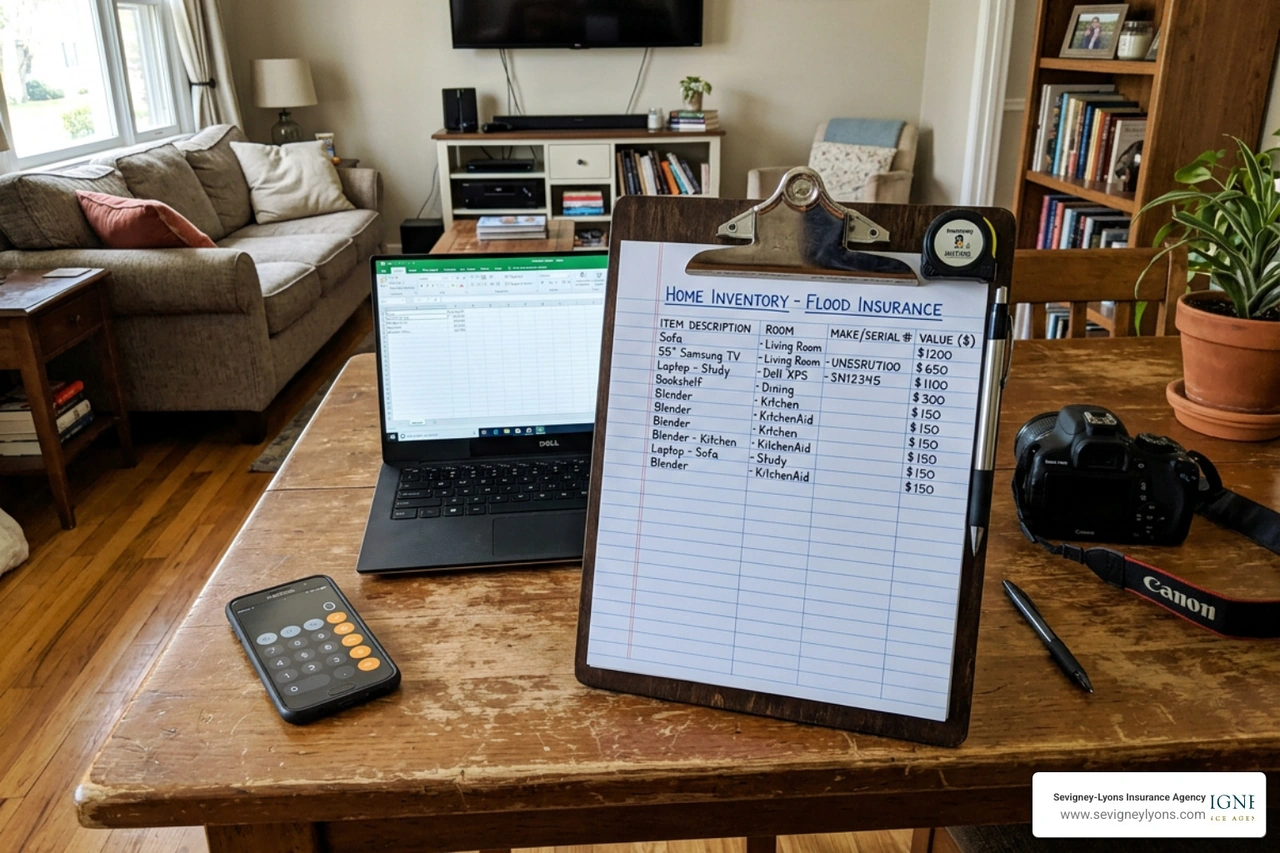
- Building Coverage: Protects the physical structure of your home, including foundations, electrical and plumbing systems, central air conditioning, water heaters, and built-in appliances like refrigerators and stoves.
- Contents Coverage: Protects your personal belongings inside the home, such as clothes, furniture, electronics, portable appliances, and rugs.
- Basement Limitations: Be aware that flood policies severely limit coverage for items located in basements (defined as any floor level below ground level on all sides). While structural elements like foundations and furnaces are covered in basements, personal belongings like couches, televisions, and finished drywall are generally excluded.
- Sewer Backups: Damage from backed-up sewers or drains is only covered if the backup is a direct result of a broader flood event in your immediate area.
The Critical 30-Day Waiting Period: Why Timing is Everything
Perhaps the most important rule of flood insurance is the 30-day waiting period enforced by the NFIP.
With few exceptions (such as when you are purchasing a policy in conjunction with a new home mortgage), a new NFIP flood insurance policy takes 30 days to become active. This rule exists to prevent people from purchasing coverage only when a major hurricane or spring storm is already tracking toward the Maine coast.
If you wait until a major storm is named or the winter snowpack begins a rapid spring melt, it will be too late. To secure peace of mind, it is crucial to establish coverage well ahead of seasonal weather patterns. Learn more about local timing and availability by exploring Maine Flood Insurance Near Me.
Frequently Asked Questions About Maine Flood Insurance
How much does flood insurance cost on average in Maine?
The average statewide premium in Maine is $944 per year. However, if your home is located in a low-to-moderate risk zone, you can purchase basic coverage starting at around $400 annually, or secure a Preferred Risk Policy for as low as $111 per year.
Can I get flood insurance if I don't live in a high-risk zone?
Absolutely. In fact, we highly recommend it. Nearly 29% of all NFIP flood claims come from outside high-risk flood areas. If you live in a low-risk zone, your premiums will be highly affordable, making it a very cost-effective way to secure peace of mind.
Does private flood insurance offer better rates than the NFIP in Maine?
In many cases, yes. Private flood insurers use proprietary technology to assess risk on a house-by-house basis. If your home has favorable elevation characteristics, private markets may offer lower premiums, higher coverage limits, and shorter waiting periods than federal programs.
Conclusion
Securing an affordable home flood policy in Maine doesn't have to be a stressful or overly expensive process. By understanding your property's specific risk, exploring both federal NFIP and private market alternatives, and utilizing community discounts, you can easily protect your home without drowning in debt.
At Sevigney-Lyons Insurance Agency, we have deep roots in Southern Maine. Serving communities across Wells, Ogunquit, Kennebunk, Biddeford, and Portland, our team has access to over 20 top insurance carriers. We specialize in tailoring personalized coverage options that match your unique budget and risk level.
Don't wait for the next major storm to test your coverage. Contact us today to secure your peace of mind.