Blog Content
Your Home Is Likely Your Biggest Investment — Here's What Protects It
Dwelling coverage insurance is the part of your homeowners policy that pays to repair or rebuild the physical structure of your home after a covered loss — like a fire, windstorm, or vandalism.
Quick answer: What does dwelling coverage insurance cover?
For homeowners in Wells, Kennebunk, Ogunquit, and Biddeford, this matters a lot. Coastal Maine homes face real risks — from nor'easters and wind-driven rain to the simple fact that construction costs in the region have climbed 30 to 40 percent since 2020. And with roughly 60 percent of U.S. homes currently underinsured by an average of 20 percent, getting this coverage right is more important than ever.
This guide breaks down everything you need to know — what dwelling coverage protects, what it doesn't, how to set the right limits, and how it fits into your overall homeowners policy.
Dwelling coverage insurance helpful reading:
What is Dwelling Coverage Insurance and How Does It Work?
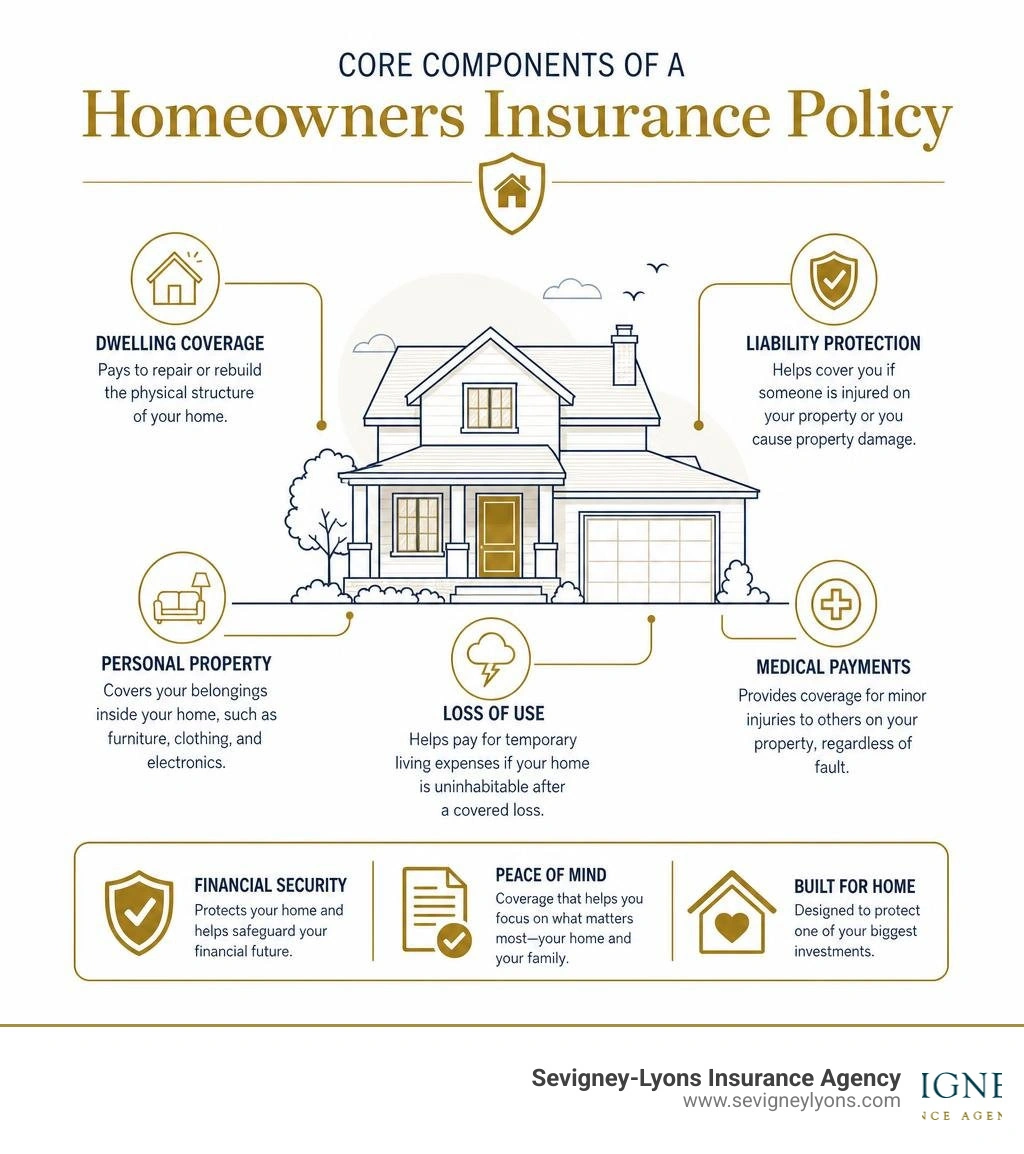
When you buy a homeowners insurance policy, you aren't just buying one single blanket of protection. Instead, your policy is divided into several distinct sections, each designed to safeguard a different aspect of your life and assets. The absolute foundation of this protection is Coverage A, widely known as dwelling coverage insurance.
Without dwelling coverage, a homeowners policy simply wouldn't exist. It is the core mechanism that secures the physical shell of your home. If a disaster strikes, this coverage is what prevents you from having to pay out of pocket to put a roof back over your head.
To fully understand how this fits into your overall protection plan, it helps to understand the Three Main Property Insurance Coverage types that form the bedrock of your policy: dwelling, personal property, and personal liability. While personal property covers your belongings (like your furniture and clothes) and liability covers legal and medical expenses if someone is injured on your property, dwelling coverage is strictly concerned with the physical "bricks and mortar" of your house.
For homeowners living in Southern Maine towns like Wells and Kennebunk, this distinction is critical. A heavy winter blizzard or a severe coastal windstorm doesn't care about your living room rug; it cares about your roof shingles and your siding. When the exterior of your home is compromised, dwelling coverage is the first line of financial defense that springs into action.
What Parts of Your Home Does Dwelling Coverage Protect?
It helps to think of dwelling coverage as protecting anything that is permanently attached to your home. If you could theoretically pick up your house, turn it upside down, and shake it, whatever doesn't fall out is generally covered under your dwelling limit.
Specifically, this includes:
- The load-bearing structures: Your foundation, exterior walls, interior walls, and floors.
- The roof and chimney: Crucial barriers against the harsh Maine elements.
- Permanently installed systems: Your plumbing, electrical wiring, heating systems, and central air conditioning.
- Attached structures: Your attached garage, a wrap-around porch, or a connected deck where you enjoy Southern Maine summers.
- Built-in appliances: Items like built-in microwaves, dishwashers, and customized kitchen cabinetry.
For example, if you own a historic home in Ogunquit or a beautiful multi-family property in Biddeford, and a fire breaks out in the kitchen, dwelling coverage will pay to replace the charred drywall, rebuild the structural support beams, replace the ruined hardwood floors, and install new built-in cabinets.
However, it is important to note that detached structures on your property—like a standalone garden shed, a separate guest cottage, or a detached woodshop—are not covered under your dwelling limit. Those fall under "Coverage B" (Other Structures), which we will compare in detail later.
Covered Perils vs. Common Exclusions in Dwelling Coverage Insurance
In the insurance world, a "peril" is an event that causes damage. Most standard homeowners policies (specifically HO-3 policies) cover your dwelling on an "open-perils" basis. This means your home's structure is protected against all causes of damage except for those specifically excluded in the policy text.
Typically, dwelling coverage will step in to repair damage caused by:
- Fire and lightning (the average fire claim alone exceeds $80,000)
- Windstorms and hail (accounting for 34% to 40% of all property claims)
- Explosions and smoke damage
- Theft and structural vandalism
- The weight of heavy snow, sleet, or ice (a major hazard for roofs in Wells and Biddeford)
- Falling objects, such as a pine tree collapsing onto your roof during a storm
While this list is extensive, standard policies also carry very strict exclusions. You cannot assume that because your house is damaged, your insurance will cover it. The most common exclusions include:
- Floods: Standard home insurance does not cover rising surface water or storm surges.
- Earthquakes: Earth movement requires a specialized rider or separate policy.
- Neglect and Wear and Tear: If your roof leaks because it is 30 years old and has missing shingles, your policy will not pay for a new roof. Maintenance is the homeowner’s responsibility.
- Sewer Backups: Water backing up through drains or sump pumps is excluded unless you purchase a specific endorsement.
For certain basic or older properties, coverage might be written on a named-perils basis rather than open-perils. Under a standard DP-1 policy form, which represents basic coverage, only explicitly listed perils (like fire and lightning) are covered. For most primary homes in Maine, however, we highly recommend comprehensive open-perils coverage to ensure no unexpected gaps leave you stranded.
Determining Your Dwelling Coverage Limits: Replacement Cost vs. Market Value
One of the most common and dangerous mistakes homeowners make is confusing their home’s market value with its reconstruction or replacement cost.
When you purchase a home in a highly desirable coastal area like Ogunquit or Kennebunk, the price you pay is heavily influenced by the location, the local school district, the view of the ocean, and the value of the land itself. However, your insurance policy does not cover the land. If your home burns to the ground, the dirt underneath it will still be there.
Therefore, your Maine Home Insurance Coverage Limits must be based entirely on the replacement cost—the actual amount of money it would take to buy raw materials and hire local contractors to rebuild your home from scratch today.
In Southern Maine, reconstruction costs are often significantly higher than standard new construction costs. Rebuilding a single home after a loss doesn't offer the same economies of scale that developers get when building an entire subdivision. Additionally, local site constraints, tree cover, and strict coastal environmental regulations can drive labor and debris removal costs up rapidly.
Furthermore, residential construction costs have risen approximately 30 to 40 percent since 2020 due to volatile lumber prices and ongoing local labor shortages. If you haven't adjusted your dwelling coverage limits recently, you may be shockingly underinsured.
The 80% Coinsurance Rule and Avoiding Underinsurance
To protect themselves from policyholders who try to save money on premiums by intentionally underinsuring their homes, insurance companies enforce what is known as the 80% coinsurance rule.
This rule states that in order to receive full payment for a partial loss, you must maintain a dwelling coverage limit that is equal to at least 80 percent of your home's total replacement cost at the time of the loss.
If your coverage falls below that 80% threshold, your insurance company will penalize you by paying only a proportional amount of your claim—even for minor damages.
The Coinsurance Penalty in Action: Let's say the actual cost to rebuild your home in Biddeford is $400,000.
- To satisfy the 80% rule, you must carry at least $320,000 in dwelling coverage.
- Instead, you only carry $240,000 (which is only 75% of the required $320,000 limit).
- A severe winter storm causes $100,000 in wind and water damage to your roof and top floor.
- Because you did not meet the 80% requirement, the insurance company will only pay 75% of your claim. You will receive $75,000 (minus your deductible), leaving you to pay the remaining $25,000 out of your own pocket.
With roughly 60 percent of homes currently underinsured, this is not a theoretical risk—it is a widespread reality. Working with an independent agency like us ensures your replacement cost is calculated accurately using localized, up-to-date construction data.
How Dwelling Coverage Compares to Other Homeowners Policy Sections
To see how dwelling coverage (Coverage A) fits into your complete security net, it helps to look at how it compares to the other primary sections of a standard homeowners policy.
To make this easier to visualize, check out the comparative structure below:

When you review your policy, you will notice that the limits for Coverages B, C, and D are almost always calculated as a direct percentage of your Coverage A (Dwelling) limit:
- Coverage B: Other Structures (Typically 10% of Coverage A)
- What it covers: Detached garages, fences, sheds, and gazebos.
- Example: If your dwelling limit is $400,000, you automatically have $40,000 to cover detached structures on your property.
- Coverage C: Personal Property (Typically 50% to 70% of Coverage A)
- What it covers: Everything inside the home—furniture, electronics, clothes, and appliances.
- Note: Personal property coverage even protects your items when you are traveling away from your Maine home, though high-value items like jewelry or fine art may require special scheduled personal property coverage.
- Coverage D: Loss of Use / Additional Living Expenses (Typically 20% to 30% of Coverage A)
- What it covers: If a fire or covered storm makes your home uninhabitable, this pays for you to rent a comparable home in the Wells or Kennebunk area, covers hotel stays, and even pays for extra restaurant meals while your home is being rebuilt.
- Personal Liability Coverage
- What it covers: Financial protection if someone is injured on your property and sues you, or if you accidentally damage someone else’s property. Unlike the other coverages, this limit is chosen independently (typically starting at $300,000 or $500,000).
For a deeper dive into how these sections interact, read our detailed Maine Home Insurance Policy Comparison.
When Do You Need Additional Dwelling Coverage Insurance Options?
Every home along the Maine coast is unique, and standard out-of-the-box policies often leave gaps. To build a truly bulletproof policy, you should consider several crucial Maine Home Insurance Coverage Options:
- Extended Replacement Cost: This endorsement adds an extra buffer (typically 25% to 50% above your Coverage A limit) to protect you if localized construction costs spike immediately following a widespread natural disaster when materials and labor are in high demand.
- Ordinance or Law Coverage: If you own an older home in Ogunquit or Kennebunk, rebuilding it after a loss will require bringing it up to current building codes. Standard policies only pay to rebuild the home as it existed. Ordinance or Law coverage helps pay for the extra expenses required to meet updated electrical, plumbing, and structural codes.
- Water Backup Endorsement: Standard policies exclude damage from backed-up sewers or failed sump pumps. Adding this option is highly recommended for homes with finished basements in Southern Maine.
- Separate Flood and Earthquake Policies: Since these are strictly excluded from standard dwelling coverage, homeowners in high-risk flood zones near the ocean or local rivers must secure separate protection.
Frequently Asked Questions about Dwelling Coverage
Navigating the nuances of insurance can be confusing. Here are the answers to the questions we hear most frequently from Southern Maine homeowners.
Is dwelling coverage the same as homeowners insurance?
No. Dwelling coverage insurance (Coverage A) is simply one component of a comprehensive homeowners insurance policy. A standard homeowners policy bundles dwelling coverage together with other structures coverage, personal property coverage, loss of use coverage, and personal liability protection to give you a complete shield of financial safety.
Does dwelling coverage pay for flood damage in Maine?
Absolutely not. This is perhaps the most common and devastating misconception in the industry. Standard dwelling coverage will cover water damage if a pipe suddenly bursts inside your walls, but it will never cover damage caused by rising surface water, storm surges, or coastal flooding.
Just one inch of floodwater can cause approximately $25,000 in damage to your home's structure. If you live near the coast in Wells, Kennebunk, or Ogunquit, you should strongly consider purchasing a separate flood insurance policy through the National Flood Insurance Program (NFIP) or a private insurer. The average NFIP policy costs around $900 per year, which is a small price to pay for total peace of mind.
How often should I update my dwelling coverage limits?
You should review your dwelling coverage limits at least once a year. Construction costs, local labor rates, and material prices change constantly. If you complete any significant home renovations—such as remodeling your kitchen in Biddeford, finishing your basement, or building a new deck—you must notify your agent immediately so your Coverage A limit can be adjusted to reflect the new replacement value of your home.
Conclusion
Your home is more than just walls and a roof—it is your sanctuary, your safe haven, and likely your most valuable financial asset. Protecting it requires more than just buying a generic policy and forgetting about it. It requires understanding the mechanics of dwelling coverage insurance, keeping your replacement cost limits up to date, and ensuring you are prepared for the unique weather risks we face here in Southern Maine.
At Sevigney-Lyons Insurance Agency, we are proud of our deep roots in the communities of Wells, Kennebunk, Ogunquit, and Biddeford. As an independent insurance agency, we don't work for one single insurance company—we work for you. We have access to over 20 of the nation's top insurance carriers, allowing us to shop around, compare rates, and design a customized protection plan tailored to your family's needs and budget.
Whether you want to review your current policy limits, explore options to lower your premium (like raising your deductible from $500 to $1,000 to save 8% to 15%), or secure a comprehensive quote, we are here to advocate for you every step of the way.
Ready to secure the ultimate protection for your castle? Explore the Best Homeowners Insurance Coverage in Maine and reach out to our local team today for a personalized policy review.