Blog Content
The Real Cost of Owning a Piece of the Maine Coast
Coastal home insurance works differently from a standard homeowners policy — and for Maine beach house owners in places like Wells, Kennebunk, and Ogunquit, understanding those differences can mean the gap between a covered claim and a devastating out-of-pocket loss.
Here's what you need to know at a glance:
- Coastal home insurance is a specialized policy (or set of policies) designed to cover risks that standard homeowners insurance excludes or limits — including windstorm damage, flood, and salt-air corrosion.
- Standard policies exclude flood damage. You need a separate flood insurance policy.
- Many carriers apply percentage-based wind deductibles for coastal properties — often 1% to 3% of your home's insured value — instead of a flat dollar amount.
- Some insurers restrict or refuse coverage for homes within 1,000 feet to 1 mile of the Maine coastline.
- State-backed plans exist as a last resort, but private and regional carriers often offer better options.
More than 25 million Americans live near the coast, and homeowners insurance premiums have more than doubled since 2019. For Maine coastal homeowners, that pressure is very real.
Southern Maine alone saw three storms with damaging coastal winds in a single six-month period. When the next one hits Wells Beach or Goose Rocks, the question isn't if your home will be tested — it's whether your insurance is built to handle it.
This guide will walk you through everything you need to evaluate your coastal coverage options with confidence.
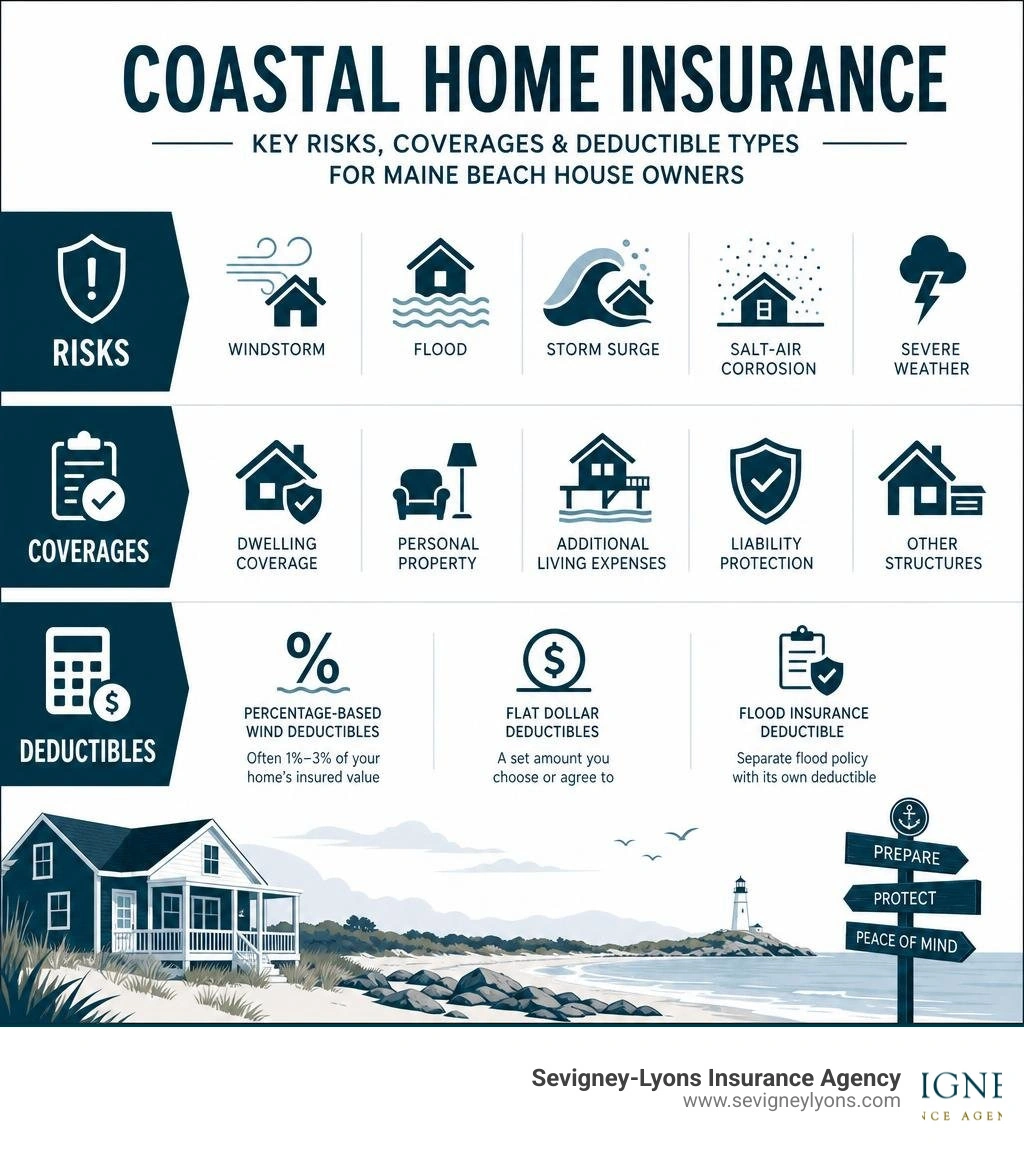
Key Coastal home insurance vocabulary:
What is Coastal Maine Home Insurance and Why Does Your Maine Beach House Need It?
When you buy a standard homeowners insurance policy (often called an HO-3 policy) for an inland home, the insurance company assumes a relatively predictable baseline of risk. They worry about kitchen fires, burst pipes, and the occasional fallen tree.
But when your home sits on the rocky coast of Ogunquit, the sandy stretches of Wells Beach, or the scenic cliffs of Kennebunkport, the risk profile changes entirely.
Coastal home insurance isn't actually a single, standardized policy type sold under that exact name. Instead, it is a coordinated protection strategy designed to handle the severe, compounding perils that waterfront properties face.
While inland homes are shielded by miles of forests, hills, and other buildings that break the force of the wind, coastal properties have no natural barriers. High winds coming off the open Atlantic hit your siding and roof at full force.
Furthermore, Maine's unique geography presents environmental challenges that standard policies are not designed to handle:
- Nor'easters and Winter Storms: While southern states worry primarily about summer hurricanes, Maine's primary threats are powerful winter Nor'easters. These storms bring a brutal combination of freezing temperatures, heavy snow, hurricane-force winds, and massive coastal storm surges.
- Salt-Air Corrosion: The very thing we love about the ocean—that salty, refreshing breeze—is a slow-motion disaster for building materials. Salt air accelerates the decay of roofing brackets, siding fasteners, exterior light fixtures, and HVAC systems. Over time, this structural degradation makes your home far more vulnerable to sudden storm damage.
- Coastal Erosion: Extreme tides and rising sea levels can slowly undermine foundations, seawalls, and bulkheads.
Because of these extreme risks, traditional insurance carriers have tightened their guidelines significantly. In recent years, many national companies have completely withdrawn from writing policies within certain coastal zip codes in Southern Maine.
To secure the right protection, you need to understand how specialized waterfront coverage bridges these gaps. To explore how these risks apply to your specific slice of the coast, take a look at our guide on Waterfront Insurance Coverage in NH & Maine.
Key Coverages and Exclusions to Evaluate
When evaluating a policy for a coastal home, you cannot simply look at the monthly premium and assume you are fully protected. You must dissect the policy's individual components to ensure there are no hidden gaps.
A comprehensive coastal insurance strategy is divided into several critical areas:
- Coverage A (Dwelling): This covers the physical structure of your home. For coastal properties, it is vital to ensure this is written on a Replacement Cost basis rather than Actual Cash Value (ACV). Replacement cost coverage pays to rebuild your home with materials of like kind and quality at current market prices, without deducting for age or wear-and-tear.
- Coverage B (Other Structures): This protects detached structures like guesthouses, standalone garages, sheds, fences, and bulkheads. On the coast, seawalls and bulkheads are frequently subjected to intense wave action, so you must verify how your policy treats these specific structures.
- Coverage C (Personal Property): This covers your belongings inside the home. Standard policies often limit personal property coverage to a strict percentage of your dwelling coverage (typically 50% to 70%). If you have high-value items, you may need to add specific scheduled endorsements.
- Coverage D (Loss of Use): If a covered storm makes your beach house uninhabitable, Loss of Use covers your temporary living expenses, such as renting an equivalent home nearby while yours is being rebuilt.
Beyond these basics, there are three specialized clauses and endorsements that are absolutely essential for coastal homeowners:
The Coinsurance Clause
Most coastal and high-value home policies include an 80% coinsurance clause. This means you must insure your home for at least 80% of its actual replacement value. If inflation or rising local construction costs push your coverage limit below this 80% threshold, your insurance company can penalize you during a claim, paying out only a fraction of your actual loss.
Ordinance and Law Coverage
This is one of the most frequently overlooked coverages in coastal Maine. Local building codes in towns like Biddeford and Wells are updated frequently to mandate storm-resistant construction materials, elevated utilities, and reinforced foundations. If your older beach house is damaged, standard dwelling coverage will only pay to rebuild it to its original specifications. Ordinance and Law Coverage pays the extra cost required to bring your rebuilt home up to current, mandatory building codes.
Water Backup and Sump Pump Overflow
Standard home policies do not cover water that backs up through sewers, drains, or sump pump wells. During a major coastal storm, heavy rains and localized flooding can easily overwhelm local municipal drainage systems, forcing water backward into your basement. Adding a water backup endorsement is a highly affordable way to protect against this common disaster.
For a deeper dive into how these various hazards are defined and covered under Maine law, read our detailed breakdown of Maine Hazard Home Insurance.
Understanding Windstorm and Coastal Home Insurance Deductibles
If you live inland, your homeowners policy likely has a single, flat deductible—usually $1,000 or $2,500. You pay that amount out of pocket, and the insurance company covers the rest of the claim.
On the coast, however, insurers split deductibles into different categories. Depending on the company and how close your home is to the water, you may face three distinct types of wind deductibles:
- Hurricane Deductibles: These only apply when damage is caused by an officially declared hurricane by the National Hurricane Center.
- Named Storm Deductibles: These are broader and are triggered by any storm officially named by the National Weather Service, including tropical storms, tropical depressions, and occasionally, named winter blizzards.
- Standard Wind/Hail Deductibles: These apply to any wind-related damage, including standard thunderstorms, localized gales, and the frequent winter Nor'easters that batter the Southern Maine coast.
The most critical difference is how these deductibles are calculated. Instead of a flat dollar amount, coastal wind deductibles are almost always written as a percentage of your home’s dwelling coverage (Coverage A).
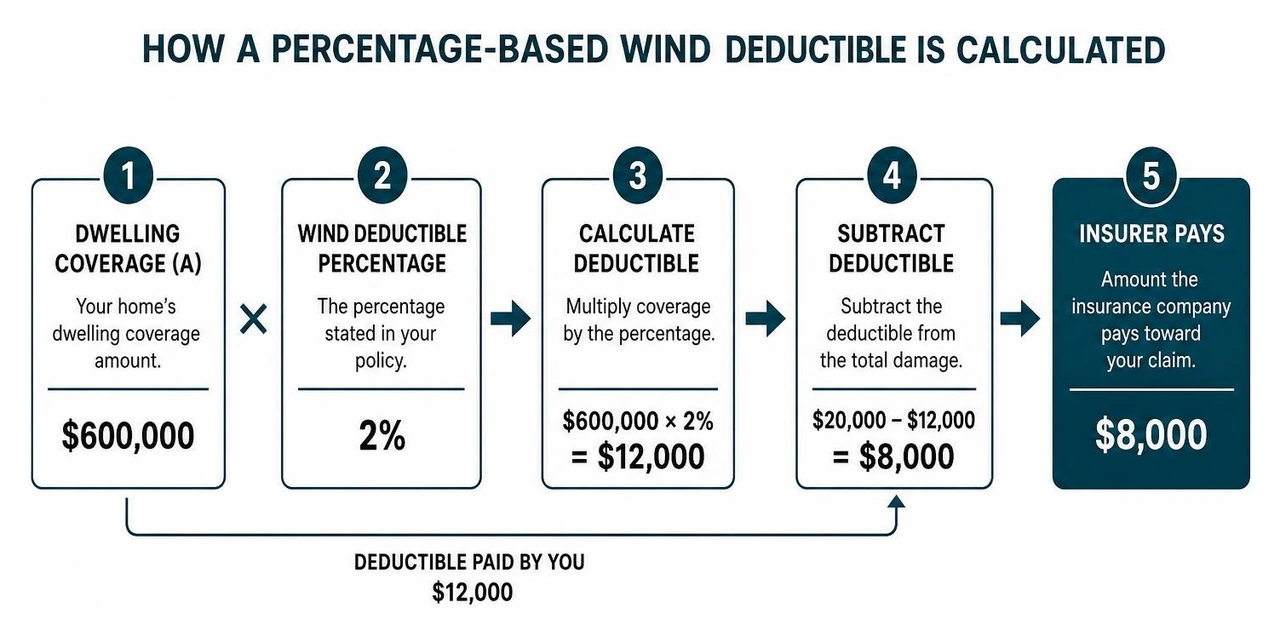
Let’s look at how this math works out in the real world:
Imagine you own a beautiful beach house in Kennebunk insured for $600,000 (Coverage A). Your policy includes a 2% windstorm deductible.
During a severe winter storm, high winds tear off a large section of your roof, causing $20,000 in physical damage.
- Your Deductible: 2% of $600,000 = $12,000
- Insurance Payout: $20,000 (total damage) - $12,000 (your deductible) = $8,000
You must pay $12,000 out of pocket before your insurance company pays a single dollar. If the damage had only been $10,000, you would have to pay for the entire repair yourself, as the loss fell below your deductible threshold.
Because these percentage-based deductibles can lead to massive, unexpected expenses, we recommend maintaining an emergency savings fund specifically earmarked to cover your maximum deductible exposure. To learn more about how to prepare for and navigate these storm-related claims, check out our guide on Maine Home Insurance for Storm Damage.
Why Flood Insurance is Separate from Coastal Home Insurance
There is a massive, incredibly common misconception among homeowners: "I have a great coastal home insurance policy, so I'm covered if the ocean floods my house."
This is completely false.
Standard homeowners insurance policies—and even specialized coastal windstorm policies—universally exclude damage caused by flooding and surface water.
If a storm tears the shingles off your roof and rain pours into your living room, that is considered wind damage and is covered by your home insurance. But if a storm surge pushes waves from the Atlantic ocean across Wells Beach and into your ground floor, that is classified as a flood. Without a separate flood insurance policy, you will have to pay for 100% of the cleanup and rebuilding costs yourself.
To protect your investment, you must purchase a dedicated flood insurance policy. Historically, almost all flood insurance was written through the federal government’s National Flood Insurance Program (NFIP). However, the private flood insurance market has expanded dramatically in Maine, offering a highly competitive alternative.
Here is how the two options compare:
If you have a federally backed mortgage (such as an FHA, VA, or conventional loan) and your property sits in a high-risk flood zone designated by FEMA (such as a Zone AE or VE), your lender will mandate that you carry flood insurance. However, even if you do not have a mortgage, or if your home is located in a moderate-to-low-risk zone, purchasing flood insurance is highly recommended.
A significant portion of flood claims occur outside of designated high-risk zones. All it takes is one severe coastal storm to cause devastating storm surge damage. You can find more information about securing the right flood protection through our Flood Insurance Coverage Agency NH & Maine page.
How Underwriters Assess Maine Coastal Properties
When you apply for coastal property insurance, underwriters do not just look at your credit score and the purchase price of the home. They use advanced catastrophe modeling software and historical weather data to evaluate the exact physical risk of your specific property.

Here are the primary factors that underwriters evaluate when determining your eligibility and premium rates:
- Distance to Tidal Water: This is often the single most important metric. Many national carriers use strict "distance-to-coast" rules. If your home is within 1,000 feet, 1,500 feet, or even one mile of the ocean, standard carriers may reject the risk entirely. Regional and specialty carriers are more flexible but will price the policy based on exact footage from the high-tide line.
- Elevation and Topography: Underwriters look at your home’s elevation relative to the Base Flood Elevation (BFE). Having an up-to-date Elevation Certificate completed by a licensed surveyor can drastically lower your flood premiums by proving your home sits safely above historical storm surge levels.
- Roof Age and Shape: Your roof is your home's first line of defense. Underwriters prefer hip roofs (which slope on all four sides) over gable roofs because they aerodynamicly channel wind up and over the home. If your roof is over 15 years old, carriers may require a roof inspection or exclude replacement cost coverage for the roof entirely.
- Foundation Design: Homes built on open pilings or piers allow storm surges and waves to pass harmlessly underneath the living structure. Homes built on standard concrete slabs or shallow basements face the full, destructive force of moving water.
- Wind Mitigation Features: You can secure substantial premium discounts by investing in certified wind mitigation improvements. These include:
- Installing a FORTIFIED Roof, which uses specialized ring-shank nails, sealed roof decks, and enhanced edge metal to prevent shingle blow-offs.
- Upgrading to impact-resistant windows or installing storm shutters.
- Elevating outdoor utilities, such as your central air conditioning compressor or heat pump, onto raised platforms.
One of the most effective ways to make your coastal property highly attractive to top-tier insurance carriers is policy bundling. If you approach an insurer asking them to write only a high-risk coastal home policy, they may decline. But if you bundle your coastal home with your auto insurance, watercraft insurance, and a personal umbrella policy, carriers are far more willing to accept the coastal risk and offer significant multi-policy discounts.
Navigating the Challenges of Coastal Home Insurance for Second Homes
Many of the beautiful properties along the Southern Maine coast in places like Ogunquit and Kennebunk are not primary residences—they are seasonal vacation homes or investment properties rented out to tourists during the summer.
Insuring a second home or a seasonal rental presents a unique set of underwriting challenges:
- The Vacancy Risk: When a home sits empty for weeks or months at a time during the autumn and winter, the risk of undetected damage skyrockets. A small roof leak from an October storm can turn into a massive mold infestation by the time you visit in the spring. A frozen pipe that bursts in January can flood the home for days before anyone notices. Consequently, insurers charge higher premiums for seasonal homes and may write strict vacancy clauses that exclude coverage if the home is unoccupied for more than 30 or 60 consecutive days.
- Short-Term Rental Exclusions: If you list your beach house on short-term rental platforms, you must disclose this to your insurer. Standard homeowners policies explicitly exclude business activities. If a guest is injured on your property or damages your home, a standard policy will deny the claim. You need a specialized short-term rental endorsement or a commercial residential policy that covers guest liability and loss of rental income.
- Market Capacity and Carrier Withdrawals: Because the coastal market is so volatile, national carriers frequently adjust their "appetite" for coastal risks, leading to sudden non-renewals.
Navigating these complexities requires a tailored approach. To learn how we structure policies specifically for seasonal and investment properties, explore our guide on Maine Home Insurance for Second Homes.
Frequently Asked Questions About Coastal Property Protection
Does standard homeowners insurance cover flood damage?
No. Standard homeowners insurance policies universally exclude damage caused by flooding, surface water, tidal water, and storm surge. To protect your home from water rising from the ground up, you must purchase a separate flood insurance policy through the National Flood Insurance Program (NFIP) or a private flood insurance carrier.
What is a percentage-based wind deductible?
Unlike a standard flat-dollar deductible (e.g., $1,000), a percentage-based wind deductible is calculated as a percentage (typically 1% to 5%) of your home’s total dwelling coverage limit (Coverage A). For example, if your home is insured for $500,000 and you have a 2% wind deductible, you must pay the first $10,000 of any wind-related damage out of pocket before your insurance coverage kicks in.
How does proximity to the water affect my insurance rates in Maine?
Proximity to the water is one of the primary factors insurers use to calculate risk. As you get closer to the ocean, the risk of high-velocity winds, salt-air corrosion, and storm surge increases dramatically. Many standard insurance carriers use strict "distance-to-coast" thresholds (such as 1,000 feet or 1,500 feet) and will refuse to write policies for homes within those boundaries. Homes closer to the water will face higher premium rates and mandatory percentage-based wind deductibles compared to homes located further inland.
Conclusion
Protecting a coastal home in Southern Maine doesn't have to mean getting soaked by astronomical premiums or buried under confusing policy exclusions. While the coastal insurance market has grown increasingly complex, securing the right coverage is entirely possible when you have the right team in your corner.
At Sevigney-Lyons Insurance Agency, we are proud to be an independent insurance agency with deep roots in Southern Maine. Because we are independent, we aren't tied to a single insurance carrier. Instead, we have direct access to over 20 of the region's top-rated insurance carriers.
Whether you own a historic cottage on the cliffs of Ogunquit, a seasonal rental in Wells, a primary residence in Kennebunk, or a waterfront home in Portland, our experienced team will shop the market to compare rates, analyze deductibles, and build a tailored protection package that fits your family's needs and budget.
Don't wait for the next winter Nor'easter to find out if your beach house is properly covered. Contact us today or request a free Maine insurance coverage quote to ensure your piece of the Maine coast is protected for generations to come.