Blog Content
Compare Commercial Condo Insurance Coverage Before You Buy
Commercial Condo Insurance Coverage works best when it fills the gaps left by the condo association's master policy. Before you compare quotes, get the association's bylaws and master-policy summary, then confirm who insures the building shell, interior fixtures, improvements, business property, and shared-loss deductibles.
For a business owner in Wells, Kennebunk, Ogunquit, or Biddeford, the key comparison is simple:
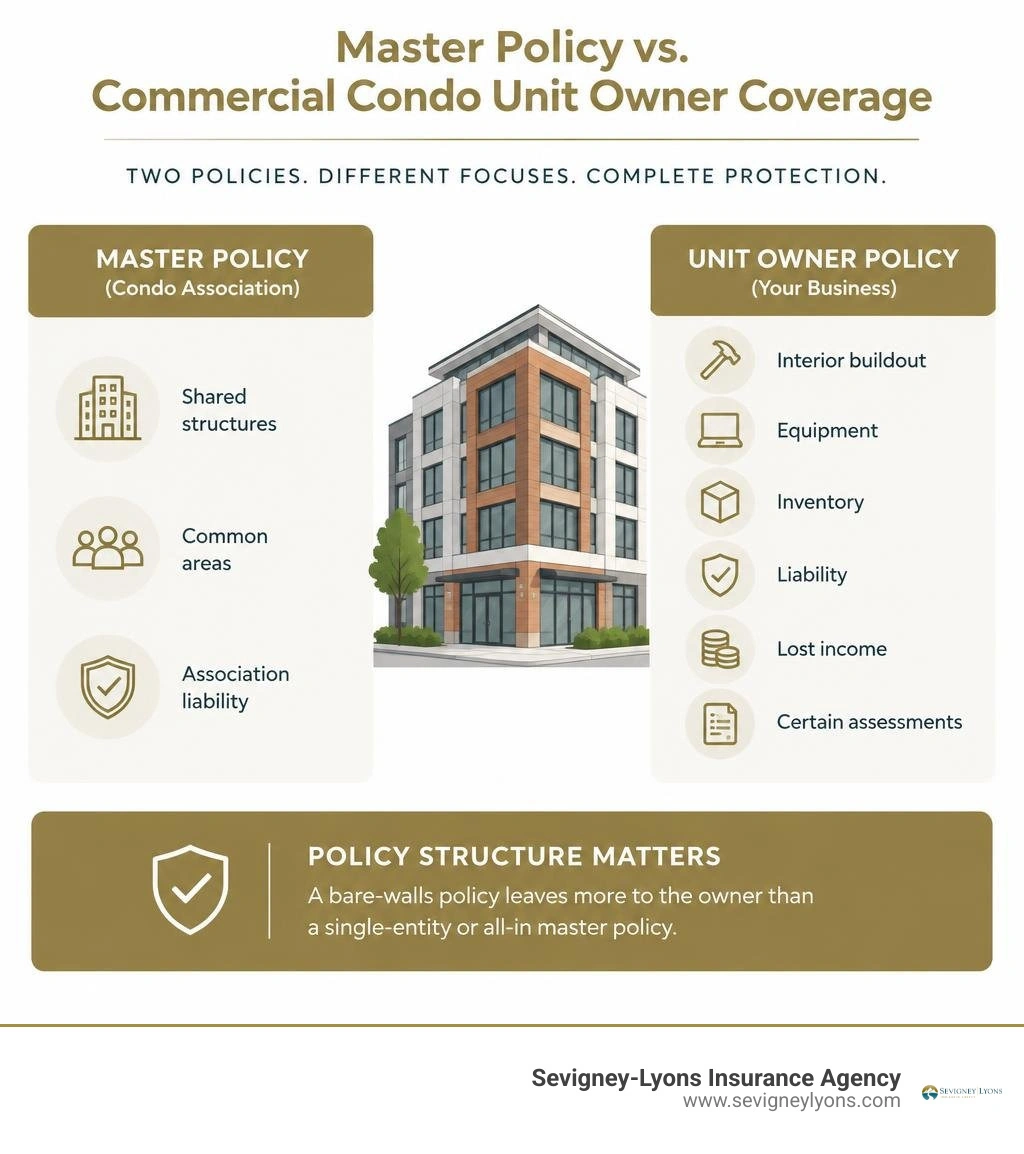
- Master policy: Usually protects shared structures, common areas, and association liability.
- Unit owner policy: Can protect your interior buildout, equipment, inventory, liability, lost income, and certain assessments.
- Policy structure matters: A bare-walls policy leaves more to the owner than a single-entity or all-in master policy.
The wrong assumption can be expensive. Custom cabinetry, signage, specialized equipment, and a share of a large association deductible may not be covered the way you expect. The next sections break down the terms so you can match coverage to your unit and business.
I'm Jon Sevigney, and I help Southern Maine business owners turn complex condo insurance terms into practical coverage decisions.
Commercial Condo Insurance Coverage word guide:
HOA Master Policies vs. Unit Owner Policies Explained
When you buy a commercial condo unit—whether it is a medical office in Biddeford, a retail boutique in Ogunquit, or a professional suite in Kennebunk—you own real estate within a shared structure. Because ownership is split between your private unit and the common elements, insurance is divided into two distinct policies: the association master policy and the individual unit owner policy.
The association’s master policy is purchased by the commercial condominium board and funded through your monthly association dues. Its primary job is to cover the exterior envelope of the property, shared structural components (such as the foundation, load-bearing walls, and roof), and common areas like parking lots, exterior walkways, lobbies, and elevators. It also provides general liability coverage if a client slips on ice in the common parking lot. For a deeper look at association obligations, review our guide on condo association insurance coverage.
However, the master policy stops where your private space begins. It does not insure your inventory, specialized equipment, customer slip-and-fall incidents inside your private doorway, or custom interior upgrades. That is why every unit owner needs an individual commercial condo insurance policy designed to mesh seamlessly with the association’s coverage.
Master Policy Structures: Bare Walls, Single Entity, and All-In
To know what your individual policy must cover, you must first identify which of the three master policy structures your association uses. These structures dictate the exact physical boundary where association responsibility ends and yours begins.
If your association carries a Bare Walls policy, you must purchase substantial building property coverage to rebuild everything from the wall studs inward. Under a Single Entity policy, the master coverage replaces base-grade fixtures, but any granite counters, custom display cases, or upgraded flooring fall entirely on your shoulders. An All-In policy covers those interior improvements through the association, though you still need coverage for your operational contents and business liability.
Lender Mandates and Maine State Legal Obligations
Navigating insurance rules requires balancing state statutes, municipal codes, and mortgage covenants. Under the Maine Condominium Act, commercial associations must maintain property insurance on common elements and liability insurance for occurrences within those areas. However, state law gives significant leeway to association bylaws regarding interior unit coverage.
If you carry a commercial mortgage on your unit in Wells or Portland, your lender will establish strict insurance mandates. Lenders typically require:
- Full replacement cost coverage on all business personal property and owner-responsible fixtures.
- Proof of building property coverage matching the replacement value required by the master policy structure.
- Business income and extra expense protection for at least 6 to 12 months.
- A mortgagee clause naming the lender as a loss payee on your policy.
Failing to align your policy with association bylaws can violate your loan covenants or leave you personally liable for rebuilding costs following a catastrophe.
Core Layers of Commercial Condo Insurance Coverage
A tailored unit owner policy brings together several essential layers of protection to defend your balance sheet. When reviewing options using a commercial property insurance comp guide, focus on these core components:
- Building & Improvements / Betterments: Covers the physical parts of the unit you own or are required to insure, including interior walls, custom millwork, flooring, and electrical upgrades.
- Business Personal Property (BPP): Protects everything inside your unit that is not bolted down—computers, desks, inventory, specialized tools, and diagnostic machinery.
- Commercial General Liability (CGL): Shields your business if a customer, vendor, or visitor is injured inside your private unit space.
Critical Protections: Business Interruption and Loss Assessment
Beyond basic property and liability, two specialized coverages are vital for commercial condo owners:
- Business Interruption (Business Income & Extra Expense): If a fire shuts down your building, the association’s policy might rebuild the roof, but it will not replace your lost operational revenue or pay your staff while repairs are underway. Business interruption replaces lost net income and pays ongoing operating expenses, while extra expense coverage helps fund temporary relocation to keep your business operating in Southern Maine.
- Loss Assessment Coverage: If the association experiences a massive property loss or liability lawsuit that exceeds the master policy limit—or if the claim is subject to a massive association deductible—the board can levy a special assessment across all unit owners. Loss assessment coverage steps in to pay your proportionate share of that bill, preventing sudden out-of-pocket financial strain.
Key Endorsements to Enhance Commercial Condo Insurance Coverage
Standard policies often exclude specialized risks that commercial operations encounter daily. To achieve comprehensive protection, consider these endorsements:
- Ordinance or Law Coverage: Pays for the increased cost of rebuilding to modern municipal building codes, which is essential for historic commercial properties throughout Kennebunk and Biddeford.
- Equipment Breakdown Coverage: Protects costly mechanical units, specialized diagnostic tools, and dedicated HVAC systems serving your space.
- Water Backup and Sump Overflow: Provides coverage if municipal drains back up into your ground-floor or basement suite.
- Cyber Liability Insurance: Defends your business against data breaches, ransom attacks, and system restoration costs.
To explore building-level protections in depth, review our insights on business property insurance in Maine.
Understanding the CP 00 18 Condominium Unit-Owners Policy
In commercial insurance, standard standalone buildings are typically insured using the CP 00 10 form. However, condo unit owners require a specialized form: the ISO CP 00 18 Condominium Commercial Unit-Owners Coverage Form.
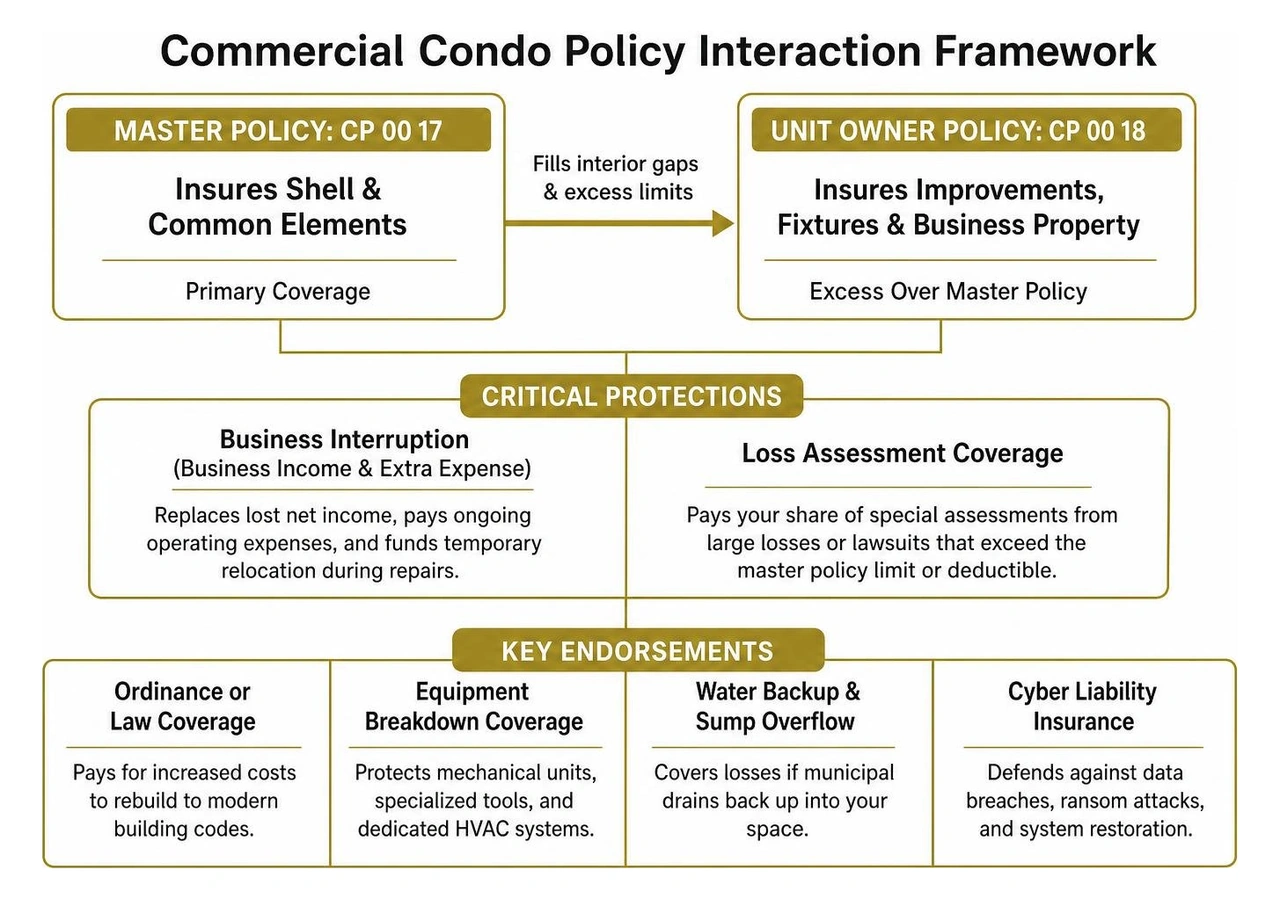
The CP 00 18 form is engineered specifically to coordinate with the association’s master property form (CP 00 17). It covers the unit owner's business personal property as well as fixtures, improvements, and alterations that are part of the building but owned by the unit owner. If you lease your unit rather than own the real estate, you may instead need commercial renters insurance in Maine.
CP 00 18 Form vs Standard Commercial Condo Insurance Coverage Forms
The crucial feature of the CP 00 18 form is its excess coverage condition. The policy explicitly states that if the condominium association carries insurance covering the same property as your unit owner policy, your CP 00 18 coverage acts as excess insurance over the master policy.
This structure avoids duplicate payouts while ensuring that if the association's policy falls short—or if the association fails to insure improvements it was required to maintain—your policy steps in to prevent a complete loss. It also contains provisions that allow mortgageholders to be protected on your portion of the real property improvements.
Common Exclusions and Policy Gaps to Watch For
No commercial insurance policy covers every conceivable event. Standard policies routinely exclude:
- Flood and Storm Surge: Commercial property forms exclude rising water and coastal storm surge, which are major considerations in coastal areas like Wells and Ogunquit. A separate commercial flood policy through the National Flood Insurance Program or private market is required.
- Earth Movement: Earthquake and sinkhole damage are standard exclusions requiring specialized endorsements.
- Wear and Tear: Gradual deterioration, rust, mold, and lack of routine maintenance are non-insurable operational risks.
- Tenant-Caused Vandalism or Neglect: If you lease your commercial condo to an outside tenant, you must require them to hold their own liability and contents coverage to protect your investment property insurance limits.
Commercial Condo Insurance Costs and Risk Mitigation in 2026
Commercial condo insurance rates have seen significant shifts in recent years, though market conditions have shown steady signs of stabilization. In 2026, the national average commercial property rate increase has leveled to roughly 3% to 5%, allowing business owners to budget with greater confidence.

When budgeting for insurance in Southern Maine, costs break down across two tiers:
- HOA Master Policies: Typically range from $3,000 to over $60,000 annually, depending on the size, construction type, and common amenities of the complex.
- Individual Unit Owner Policies: Generally cost between $500 and $3,500 per year for standard business occupancies.
Cost Drivers Across Commercial Building Types
The annual premium for an individual unit owner depends heavily on the operational risk of the business and the nature of the building:
- Office Condos: Typically range from $1,000 to $4,000+ per year. Low foot traffic and minimal hazard exposure make professional services (attorneys, accountants, software firms) cost-effective to insure.
- Retail Condo Units: Range from $1,500 to $5,000+ per year. High public foot traffic increases premises liability exposure, while inventory loading impacts personal property premiums.
- Industrial and Warehouse Condos: Range from $1,000 to $6,000+ per year. Heavy machinery, specialized loading docks, and hazardous storage factors drive property and liability costs.
- Medical Office Condos: Often fall between $2,000 and $6,500+ annually due to high-value diagnostic equipment and specialized plumbing/electrical buildouts.
Underwriters also pay close attention to Insurance to Value (ITV) adjustments, ensuring replacement cost values reflect current construction labor and material pricing.
Strategic Ways Boards and Owners Can Lower Premiums
Managing insurance costs does not mean sacrificing vital protection. Associations and unit owners can implement several risk mitigation practices:
- Adjust Deductibles Thoughtfully: Increasing an individual unit property deductible from $1,000 to $2,500 or $5,000 can yield meaningful annual premium savings, provided your cash reserves can absorb the difference.
- Document Roof and System Maintenance: Maintain strict logs of roof inspections, HVAC servicing, and plumbing checkups. Underwriters reward proactive property management with preferential rates.
- Upgrade Life Safety Systems: Installing central-station fire alarms, monitored sprinkler systems, and smart water-leak shutoff sensors can earn substantial policy credits.
- Conduct Annual Policy Audits: Review your property values and inventory figures annually with your agent to ensure you are not paying for obsolete equipment limits.
- Bundle Commercial Lines: Packaging your property, general liability, commercial auto, and umbrella coverage through a single carrier portfolio maximizes multi-policy discounts.
To explore building-wide risk strategies, consult our resource on condo building insurance in Maine.
Document Checklist and Costly Buyer Mistakes to Avoid
Securing accurate commercial condo coverage requires organized documentation before submitting an application. Make sure you have the following records available:
- Three to four years of verifiable commercial loss runs.
- The condo association declaration, bylaws, and master insurance summary.
- A current property appraisal or detailed buildout invoice list.
- The association’s annual operating budget and reserve study.
- A clear plot plan and color photographs of the unit and exterior.
To keep your investment secure, explore our analysis of commercial condo insurance in 2026 and avoid these common buyer mistakes:
- Assuming the Master Policy Covers Improvements: Believing the association covers your high-end interior finishes is the single most common—and expensive—misunderstanding in commercial condo ownership.
- Skipping Loss Assessment Coverage: Leaving off this endorsement leaves you exposed to surprise special assessments if the association faces a deductible or liability shortfall.
- Ignoring Master Policy Deductibles: Some master policies carry wind/hail or water deductibles of $25,000 to $50,000. If an association loss occurs, your unit could be assessed a significant share of that cost.
- Failing to Purchase Ordinance or Law Endorsements: If local zoning or building codes require upgrades during post-loss repairs, standard policies will not cover the added expense without this endorsement.
Frequently Asked Questions about Commercial Condo Insurance
Do I need a commercial condo policy if my association has a master policy?
Yes. The association’s master policy only protects shared structural components and common areas. It does not cover your interior buildout improvements, business personal property, inventory, specialized equipment, business income loss, or liability for accidents occurring inside your private unit.
How does loss assessment coverage protect commercial unit owners?
Loss assessment coverage pays your proportionate share of special assessments levied by the condo association when a major covered property or liability loss exceeds the master policy limit, or when the association must fund a substantial master policy deductible.
What is the difference between bare walls and all-in condo insurance?
A Bare Walls master policy covers only the bare exterior shell and structural studs, requiring unit owners to insure all drywall, flooring, lighting, and fixtures. An All-In master policy covers the exterior shell, original interior fixtures, and built-in upgrades, leaving unit owners responsible primarily for personal property, movable equipment, and private liability.
Conclusion
Securing the right commercial condo coverage is all about balance. When your unit policy coordinates seamlessly with your association's master policy, you eliminate costly coverage overlaps while ensuring no hazardous gaps remain.
At Sevigney-Lyons Insurance Agency, our team brings decades of local experience and access to over 20 leading commercial carriers to help Maine business owners safeguard their physical spaces and operational livelihoods. Whether you operate out of Wells, Kennebunk, Ogunquit, or Biddeford, we take the time to review your association bylaws, evaluate your unique buildout, and construct a tailored insurance plan built around your exact needs.
Take the guesswork out of your business protection. Reach out to our team today to explore our commercial insurance coverage options and secure the right coverage for your commercial condominium.