Blog Content
What "Full Coverage" Auto Insurance Really Means (And Why It Matters)
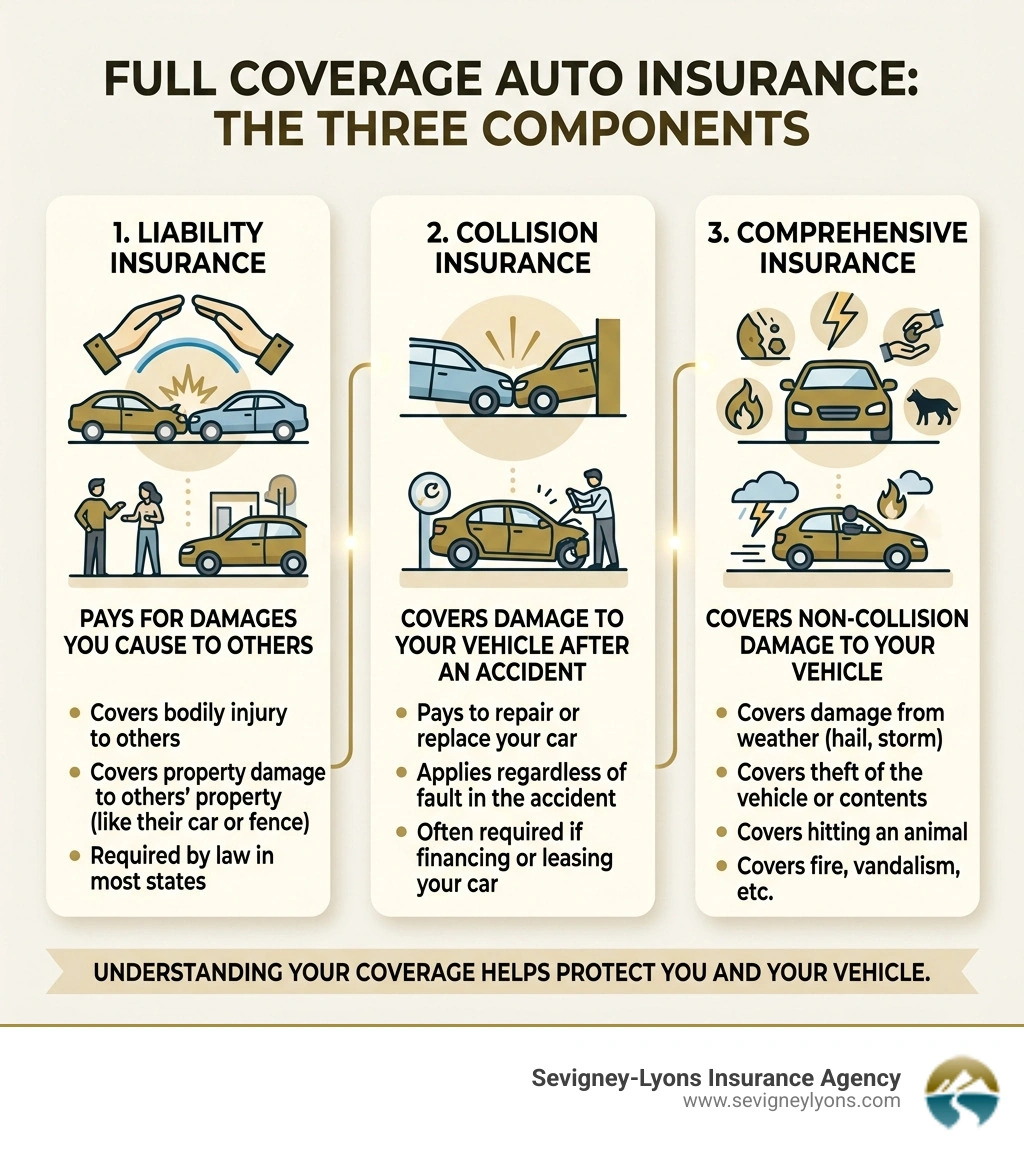
Full coverage auto insurance is not a single, official policy — it's a term used to describe a combination of three core coverages: liability, collision, and comprehensive.
Here's what each one does:
- Liability — Pays for injuries and property damage you cause to others
- Collision — Covers damage to your vehicle after an accident, regardless of fault
- Comprehensive — Covers non-collision damage like theft, weather, fire, or hitting an animal
"Full coverage" sounds like a safety net that covers every possible scenario — but it's more nuanced than that.
Many drivers assume full coverage means everything is covered. It doesn't. Limits, deductibles, and exclusions still apply. And no two policies are identical.
For drivers in Southern Maine — whether you're commuting along Route 1 through Wells, running a business in Biddeford, or heading into Kennebunk — understanding exactly what your policy includes (and what it doesn't) can save you from a very expensive surprise.
The good news? Once you know the basics, it's straightforward to build a policy that actually fits your life and budget.
Simple guide to Full coverage auto insurance:
What is Full Coverage Auto Insurance?
As of April 2026, the term Full coverage auto insurance remains one of the most searched yet misunderstood phrases in the industry. Technically, if you walk into our offices in Wells or Biddeford and ask for a "full coverage" policy, we know exactly what you mean: you want protection for both the damage you might cause to others and the damage that might happen to your own vehicle.
However, it is vital to understand that "full" does not mean "limitless." A standard policy under this umbrella typically bundles three distinct types of insurance:
- Liability Insurance: This is the bedrock of your policy. It includes Bodily Injury and Property Damage. If you are at fault in an accident in Ogunquit, this pays for the other driver's medical bills and car repairs.
- Collision Insurance: This pays to repair or replace your vehicle if you hit another car or an object (like a guardrail or a tree), regardless of who was at fault.
- Comprehensive Protection: This covers "acts of God" or incidents outside of a collision. Think of a Maine winter storm dropping a heavy branch on your windshield, or a deer darting across the road in Kennebunk.
Using a Full Coverage Automobile Insurance Guide helps clarify that this bundle provides asset security. Without collision and comprehensive, you are essentially "self-insuring" your vehicle, meaning you would have to pay out-of-pocket for any repairs to your own car.
Understanding the Core Components of Full Coverage Auto Insurance
To truly grasp how these pieces fit together, we need to look at the mechanics of the policy.
- Bodily Injury (BI): This covers medical expenses, lost wages, and even legal fees if someone sues you after an accident. In Maine, the costs of serious injuries can easily reach hundreds of thousands of dollars.
- Property Damage (PD): This pays for the repair of someone else’s property—usually their car, but it could also be a fence or a storefront in downtown Portland.
- Deductible Choices: Collision and comprehensive coverages almost always come with a deductible. This is the amount you agree to pay out-of-pocket before the insurance company kicks in. Common choices are $500 or $1,000.
- Out-of-Pocket Costs: There is an inverse relationship between your deductible and your premium. A higher deductible usually means a lower monthly payment, but it also means you need to have that cash ready in the bank if you have a claim.
Is Full Coverage Auto Insurance Required by Law in Maine?
The short answer is: No, the state of Maine does not require "full coverage."
By law, Maine drivers must carry a minimum amount of liability insurance. As of 2026, these requirements ensure that you can cover damages to others. According to the Maine Bureau of Insurance, these mandates are designed to protect all motorists on the road. However, the state does not force you to protect your own vehicle.
So, why do so many people have it?
- Lender Mandates: If you are financing or leasing your car, your lender will almost certainly require you to carry Full Coverage Auto Insurance Maine. They want to ensure their investment (your car) is protected if it's totaled.
- Financial Protection: Even if your car is paid off, can you afford to buy a new one tomorrow if yours is stolen or crushed by a falling tree?
- Biddeford and Local Regulations: While state law is uniform, local lenders and dealerships in Biddeford or Saco may have specific requirements for the proof of insurance you must provide before driving off the lot.
The Cost of Protection in Southern Maine
Pricing for Full coverage auto insurance varies significantly based on how much protection you choose. Nationally, some drivers pay over $4,000 a year for high-limit policies, but local averages often tell a different story.
In Maine, we are fortunate to often see lower rates than the national average, but your specific Maine Full Coverage Auto Insurance Rates will depend on several factors. For instance, a policy with 100/300/100 liability limits and $500 deductibles for comprehensive and collision typically averages around $1,895 annually.
Factors Influencing Your Monthly Premiums
Why does your neighbor in Kennebunk pay less than you do? Several variables are at play:
- Vehicle Model: A brand-new electric SUV costs more to repair (and therefore more to insure) than a five-year-old sedan.
- Driver Age: Younger, less experienced drivers in Wells will face higher premiums due to the statistically higher risk of accidents.
- Location Factors: Rates in more densely populated areas like Portland or Biddeford might be slightly higher than in rural parts of the state due to the increased frequency of minor "fender benders."
- Credit Score Impact: In many cases, your credit history can influence your "insurance score," which companies use to help determine your premium.
- Driving History: A clean record is your best friend. Even one speeding ticket on the Maine Turnpike can cause your rates to climb.
When is Full Coverage Required or Recommended?
Deciding whether to opt for Full coverage auto insurance usually comes down to two things: who owns the car and what the car is worth.
Financing and Leased Vehicles
If you are currently making payments on your vehicle, the decision has likely been made for you. Banks and leasing companies require collision and comprehensive coverage to protect their collateral. If you drop these coverages, the lender may "force-place" insurance on your behalf, which is significantly more expensive and provides less protection for you.
Commuter Risks
Do you commute from Wells to Portland every day? The more time you spend on the road, the higher your statistical chance of an incident. Whether it's a hit-and-run in a parking lot or a multi-car pileup during a snowstorm, having a policy that covers your own vehicle provides peace of mind that a liability-only policy cannot.
You might find yourself asking, "Do I Need Full Coverage Auto Insurance?" if your car is older. This is where the "10% rule" comes in.
Deciding on Coverage for Older or Paid-Off Vehicles
As a vehicle ages, it undergoes depreciation. Eventually, the cost of the premium plus your deductible might exceed the "Actual Cash Value" (ACV) of the car. You can check your vehicle's current market value through online valuation tools to help with this calculation.
- The 10% Rule: A common rule of thumb is that if the annual cost of your collision and comprehensive coverage exceeds 10% of your car’s total value, it might be time to drop it.
- Repair Costs: Consider the cost of parts. Even for an older car, Maine Comprehensive Car Insurance Rates might be worth it if the vehicle has rare parts that are expensive to replace.
- Financial Risk Tolerance: If your car is worth $3,000 and you have a $1,000 deductible, the most you would ever receive from a claim is $2,000. If you can afford to lose $2,000 without it ruining your finances, you might consider dropping to liability-only.
Optional Add-ons to Enhance Your Policy
While "full coverage" typically refers to the big three (liability, collision, comprehensive), you can tailor your policy with several "riders" or endorsements:
- Gap Insurance: If your new car is totaled, the insurance company pays the market value. If you owe more on your loan than the car is worth, Gap insurance pays that "gap."
- Roadside Assistance: Essential for those cold Maine mornings when a battery dies or you lock your keys in the car while visiting Ogunquit.
- Rental Reimbursement: "Full coverage" does not automatically give you a free rental car while yours is in the shop. You need this specific add-on.
- Uninsured/Underinsured Motorist (UM/UIM): This is critical. If someone hits you and they don't have insurance (or don't have enough), this coverage steps in to pay for your injuries and damage.
- SR22 Insurance: If you've had a lapse in coverage or a serious violation, you might need SR22 Insurance Full Coverage in Maine to prove to the state that you are financially responsible.
Frequently Asked Questions about Full Coverage Auto Insurance
Does full coverage auto insurance cover rental cars?
Generally, yes. If you have a personal Full coverage auto insurance policy, those protections (liability, collision, and comprehensive) usually extend to a rental car you use for personal travel. However, there are caveats. Your limits remain the same, and your deductible still applies. If you are renting a luxury vehicle in Ogunquit but your personal car is a base-model sedan, your coverage limits might not be high enough. Always check with your agent before declining the rental company's waiver.
When should I drop full coverage from my policy?
You should consider dropping it when the annual premium for collision and comprehensive equals or exceeds the potential payout you’d get after an accident. Use a Maine Comprehensive Car Insurance Compar tool to see if the math still makes sense for your older vehicle. If your car is only worth $1,500 and your deductible is $500, you are paying a premium to protect a maximum of $1,000.
How do I know if I have full coverage auto insurance?
The easiest way is to look at your Declarations Page. This is the summary page of your policy. Look for line items for "Collision" and "Comprehensive" (sometimes called "Other Than Collision"). If you see those listed with a deductible amount next to them, you have what is informally known as full coverage. If you only see "Bodily Injury" and "Property Damage," you likely have a liability-only policy.
Conclusion
Navigating Full coverage auto insurance doesn't have to be a solo journey. At Sevigney-Lyons Insurance Agency, we pride ourselves on being more than just a place to buy a policy; we are your neighbors in Wells, Kennebunk, Ogunquit, and Biddeford.
As an independent agency, we have access to over 20 top carriers, allowing us to shop around and find the best fit for your specific needs. Whether you’re looking to protect a brand-new vehicle or trying to decide if it’s time to drop coverage on an older one, our deep community roots and decades of experience ensure you get a tailored solution, not a one-size-fits-all package.
Don't leave your financial security to chance. Reach out to us today to review your current policy and ensure you have the protection you deserve.