Blog Content
What Is RV Insurance and Why It Matters in Maine
RV insurance is a specialized policy that protects your recreational vehicle — and everything inside it — in ways a standard auto policy simply cannot.
Here's a quick snapshot of what it covers and who needs it:
- What it is: A dedicated policy covering motorhomes and trailers for damage, theft, liability, and personal belongings
- Who needs it: Anyone who owns a motorhome, travel trailer, fifth-wheel, or camper van — especially in Maine where road trips from Wells to Ogunquit are a way of life
- Is it required? Yes, for motorized RVs in nearly every state. Maine requires minimum liability coverage before you drive a motorhome on public roads
- What it costs: Motorhome liability policies can start as low as $125 per year, with total cost depending on your RV type, driving history, and coverage choices
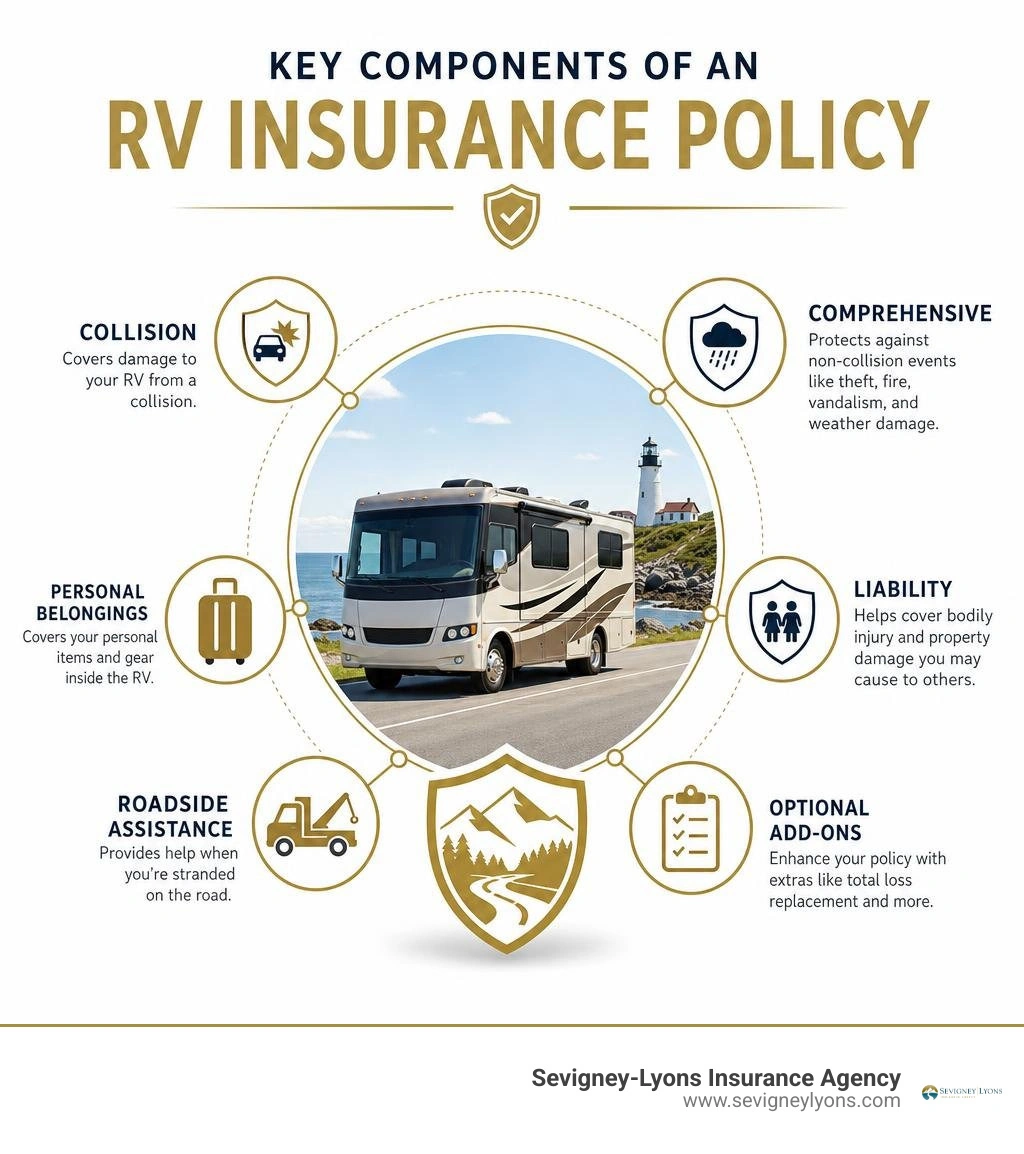
- Key coverages: Collision, comprehensive, liability, personal belongings, roadside assistance, and optional add-ons like total loss replacement
Whether you're weekend camping in Kennebunk or living full-time in your rig, a standard auto policy leaves dangerous gaps in protection. RV insurance fills those gaps.
I'm Jon Sevigney, and in this guide I'll walk you through everything you need to compare RV insurance quotes and find the right coverage for your situation.
Understanding RV Insurance vs Standard Auto Insurance
When new RV owners stop by our office in Wells or call us from Biddeford, one of the first questions they ask us is: "Why can't I just add my camper to my existing auto policy?"
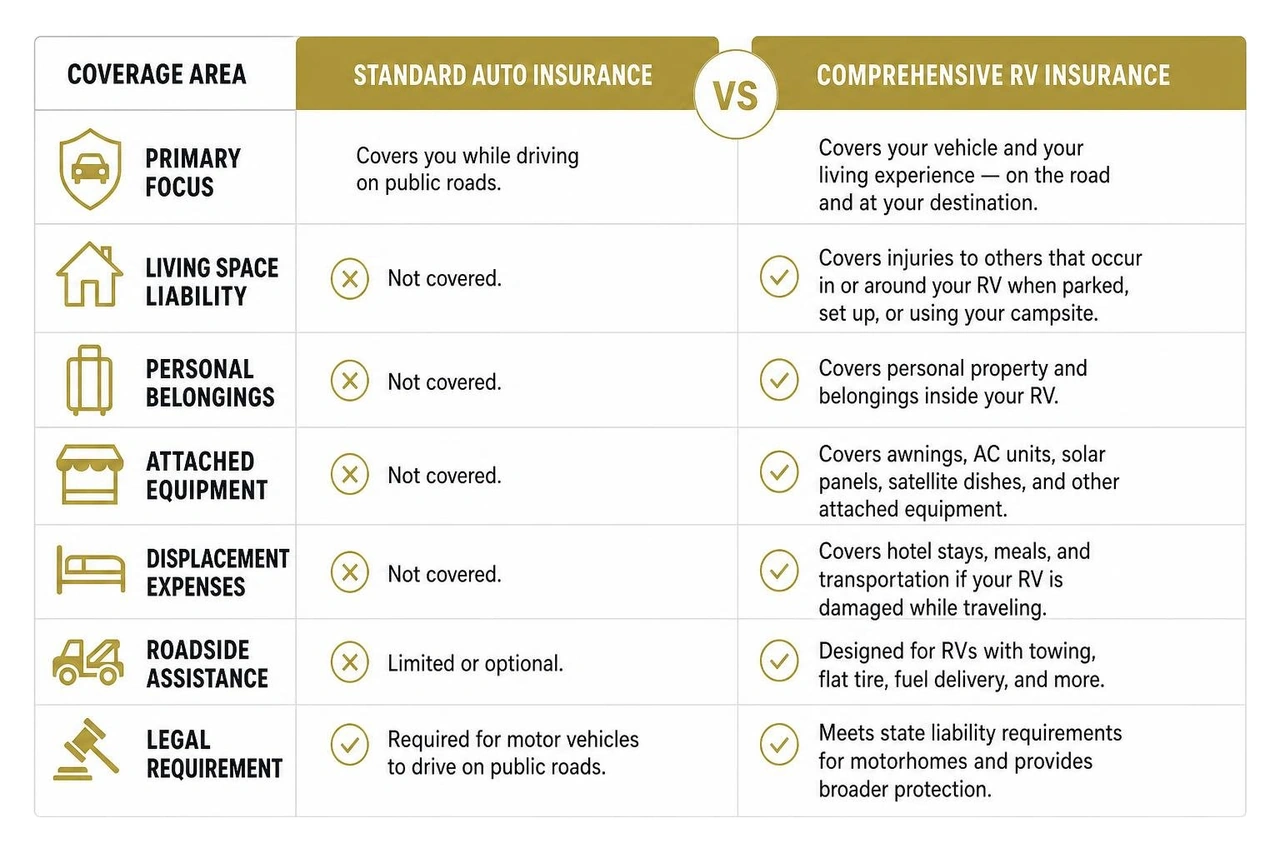
It is an understandable question. Both vehicles run on wheels, navigate the Maine Turnpike, and park in driveways. However, treating a recreational vehicle like a commuter sedan leaves major gaps in your financial security. Standard automobile policies are engineered strictly for transportation—paying for body repairs, liability, and medical bills resulting from a roadway collision.
A recreational vehicle, by contrast, functions simultaneously as a heavy motor vehicle and a temporary or permanent dwelling unit. To learn more about these fundamentals, check out our guide on What is RV Insurance.
Consider what happens when you pull into a campsite near Ogunquit. Once you set your leveling jacks, unhook your towing rig, and slide out your living area, your vehicle shifts from a moving hazard to a home base. Standard auto policies stop providing meaningful protection the moment the vehicle stops moving. They do not account for:
- Living space liabilities: Someone slipping on your camper steps or tripping over a lawn chair on your patio space.
- Personal property inside: Thousands of dollars worth of clothes, electronics, cookware, fishing gear, and camping supplies stored inside.
- Attached equipment: Retractable shade awnings, roof-mounted air conditioners, satellite dishes, solar panels, and outdoor kitchen units.
- Displacement costs: Hotel rooms, temporary meal allowances, and emergency transportation if your living quarters are damaged far from home.
Specialized rv insurance bridges the divide between automotive protection and home insurance, wrapping vehicle coverage and residential protection into a single seamless policy.
Key Legal Requirements for Maine RV Insurance
Understanding legal mandates for recreational vehicles depends heavily on whether your vehicle moves under its own motor power or requires a tow hitch.
In the state of Maine, motorized RVs (Class A, Class B, and Class C motorhomes) are legally classified as motor vehicles. That means you are required by law to carry state minimum liability insurance, as outlined by the Maine Bureau of Insurance, before driving onto public roads. Liability insurance pays for bodily injury and property damage you cause to other drivers or property owners in an accident. If you are taking a weekend trek through Kennebunk or driving up Route 1, rolling onto public asphalt without motorhome liability coverage can result in heavy fines, license suspension, and severe personal liability.
Towable trailers—such as fifth-wheels, conventional travel trailers, pop-ups, and toy haulers—operate under different legal guidelines:
- State liability laws: In almost all jurisdictions, including Maine, bodily injury and property damage liability automatically extend from the towing vehicle to the trailer while the trailer is hitched and in motion. Because of this, state law does not mandate a separate liability policy for a towable camper on the road.
- Lender requirements: If you finance or lease your travel trailer or fifth-wheel, your bank or lender will strictly require you to maintain comprehensive and collision coverage. They want to ensure their financial investment is protected against crashes, fallen tree limbs, hail damage, roll-overs, and theft regardless of legal minimums.
- Stationary protection: While your truck's auto policy might handle liability while driving down the highway, it stops dead the moment you unhitch at a campsite. Without specialized trailer protection, physical damage to the unit or liability claims while parked fall entirely on your pocketbook.
Types of Motorhomes and Trailers Insured
Recreational vehicles come in all shapes, sizes, and price points. Insurance policies are structured around the exact classification and structural risk of your rig.
Motorized RVs (Drivable)
- Class A Motorhomes: These are the titans of the RV world, built on commercial bus or heavy truck chassis and ranging anywhere from 21 to 40 feet (or longer). Featuring full kitchens, master bedrooms, and slide-outs, they represent a significant financial investment requiring high liability limits, total loss protection, and physical damage coverage.
- Class B Camper Vans: The fastest-growing segment among road-trippers, Class B units are built within standard driver van frames. They are nimble, easier to park along tight Ogunquit streets, and fuel-efficient, yet still require specialized coverage for custom interior build-outs, solar systems, and plumbing installations.
- Class C Motorhomes: Distinctly recognized by their over-cab sleeping alcove, Class C rigs range from 20 to 33 feet in length. Built on a cutaway truck chassis, they provide a wonderful middle ground for families traveling between Biddeford and coastal campgrounds, blending substantial living space with familiar driving mechanics.
Towable RVs (Pulled by a Tow Vehicle)
- Fifth-Wheel Trailers: Attached to a special jaw-hitch inside the bed of a pickup truck, fifth-wheels offer bi-level floor plans and spacious living quarters. Their high value and structural size require robust comprehensive, collision, and campsite liability coverage.
- Conventional Travel Trailers: Spanning from 12 to 40 feet, standard travel trailers hitch directly to a frame bumper. They face risks from highway swaying, backing into trees, storm damage, and theft.
- Pop-Up Campers and Truck Campers: Lightweight and collapsible, pop-ups offer an economical entryway to camping. Truck campers sit directly in a pickup bed. Both need physical protection against canvas tearing, water intrusion, road hazards, and theft.
Essential Coverages Included in a Comprehensive Policy
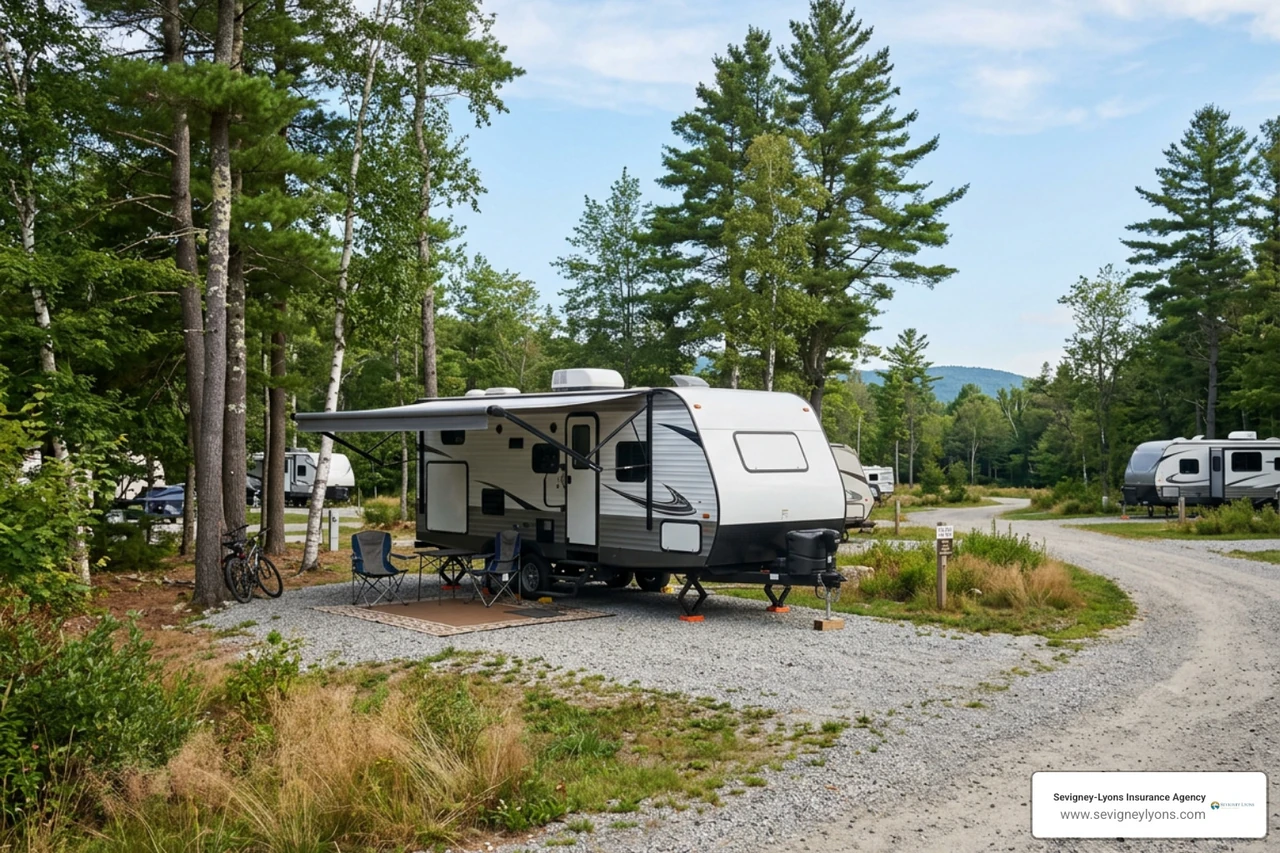
A well-crafted policy combines core automotive coverages with specialized recreational endorsements. When we review policies with our clients across Southern Maine, we break protection down into clear, understandable layers.
Core Protections and Personal Property
- Collision Coverage: Pays to repair or replace your motorhome or trailer if it is damaged in a rollover or crash with another vehicle, guardrail, tree, or structure—regardless of who is at fault.
- Comprehensive Coverage: Protects your vehicle against non-collision incidents. This includes damage from hail, falling tree limbs during coastal windstorms, vandalism, fire, theft, animal strikes (such as hitting a deer), and glass breakage.
- Liability Protection (Bodily Injury & Property Damage): Crucial for motorized RVs, liability covers legal fees, settlement costs, and medical bills if you cause an accident resulting in injury or property destruction to others.
- Uninsured/Underinsured Motorist (UM/UIM): Protects you, your family, and your passengers if you are struck by a driver who carries insufficient insurance or flees the scene.
- Medical Payments: Covers immediate medical expenses for you and your passengers following an accident, regardless of liability.
- Personal Belongings Replacement: Standard auto policies limit coverage for personal belongings to trivial amounts. Specialized policies allow you to insure clothes, laptops, camping gear, cookware, and televisions at full replacement cost up to specified policy limits (often up to $3,000 or higher).
- Permanent Attachments and Equipment: Protects structural additions that didn't come standard from the factory—such as custom patio awnings, solar panel arrays, satellite equipment, and external storage units—guaranteeing they are replaced without heavy depreciation deductions.
Total Loss Replacement and Specialized Add-ons
For newer recreational vehicles, market value depreciation is a major financial risk. The moment you drive a brand-new Class A motorhome or fifth-wheel off the dealer lot, its retail value drops. If a major highway accident or severe fire totals your vehicle in the first few years, standard actual cash value (ACV) coverage only pays what the used RV was worth a minute before the accident—leaving you with a massive gap if you owe money on a loan.
That is where specialized replacement coverages make a dramatic difference:
Beyond structural loss protection, tailored policies offer practical endorsements designed for real-world travel problems:
- Roadside Assistance: 24/7 emergency assistance tailored for heavy vehicles, providing specialized towing to qualified repair centers, flat-tire changes, fuel delivery, and battery jump-starts.
- Emergency Expense Allowance: If your rig breaks down or is involved in a covered accident more than 50 miles from your home in Wells or Biddeford, this pays up to $750 for temporary hotel lodging, transportation, food, and fuel costs.
- Pet Injury Coverage: Our four-legged family members love camping trips just as much as we do. Pet injury coverage pays up to $1,000 in veterinary bills with $0 deductible if your cat or dog is hurt in an accident while riding inside the RV.
- Roof Protection Plus: Designed for motorhomes and trailers less than six years old, this protects against roof structure failures, wear-and-tear damage, and water leakage with a low $250 deductible.
Full-Time RV Living: Specialized Coverage for Primary Residences
A growing number of people in Maine and across the country are ditching traditional brick-and-mortar homes to embrace living in their RV full-time. If you reside in your motorhome or travel trailer for more than six months out of the year (184+ days), standard recreational policies no longer apply. You require full-time RV insurance.
When you transition to full-time status, your risk profile changes entirely. You no longer have a primary homeowners policy to cover personal liabilities, guest injuries, or property damage away from the vehicle. Full-time coverage functions as a hybrid between comprehensive auto insurance and a traditional homeowners policy. For an in-depth breakdown of regional considerations, review our Maine RV Insurance Complete Guide.
Key elements built into full-time coverage include:
- Full-Timer’s Personal Liability: Replaces home liability coverage. It protects you if a visitor slips and falls inside your camper, if your dog bites someone at a park, or if you accidentally damage surrounding property while parked. Coverage options typically range from $50,000 up to $500,000.
- Medical Payments to Others: Covers reasonable medical bills for guests injured in or around your unit, regardless of fault.
- Loss Assessment Protection: If you park long-term in a co-op campsite or RV resort association, the association may levy assessment fees against residents to pay for shared property damage (like storm damage to community clubhouses). Loss assessment coverage pays up to $5,000 for these shared expenses.
- Adjacent Structures Coverage: Protects permanent structures you set up on your deeded or rented lot, such as storage sheds, decks, screen rooms, and carports.
RV Policy Costs and Ways to Save
How much should you expect to pay for protection? Because recreational vehicles vary so wildly—from a simple $10,000 pop-up camper to a $300,000 diesel pusher—premiums vary based on several key factors. Baseline liability policies for simple motorhomes can start as low as $125 per year, while full comprehensive packages for luxury full-time rigs cost significantly more.
To get an immediate sense of your rates, you can request an Instant RV Insurance Quote tailored to your specific vehicle.
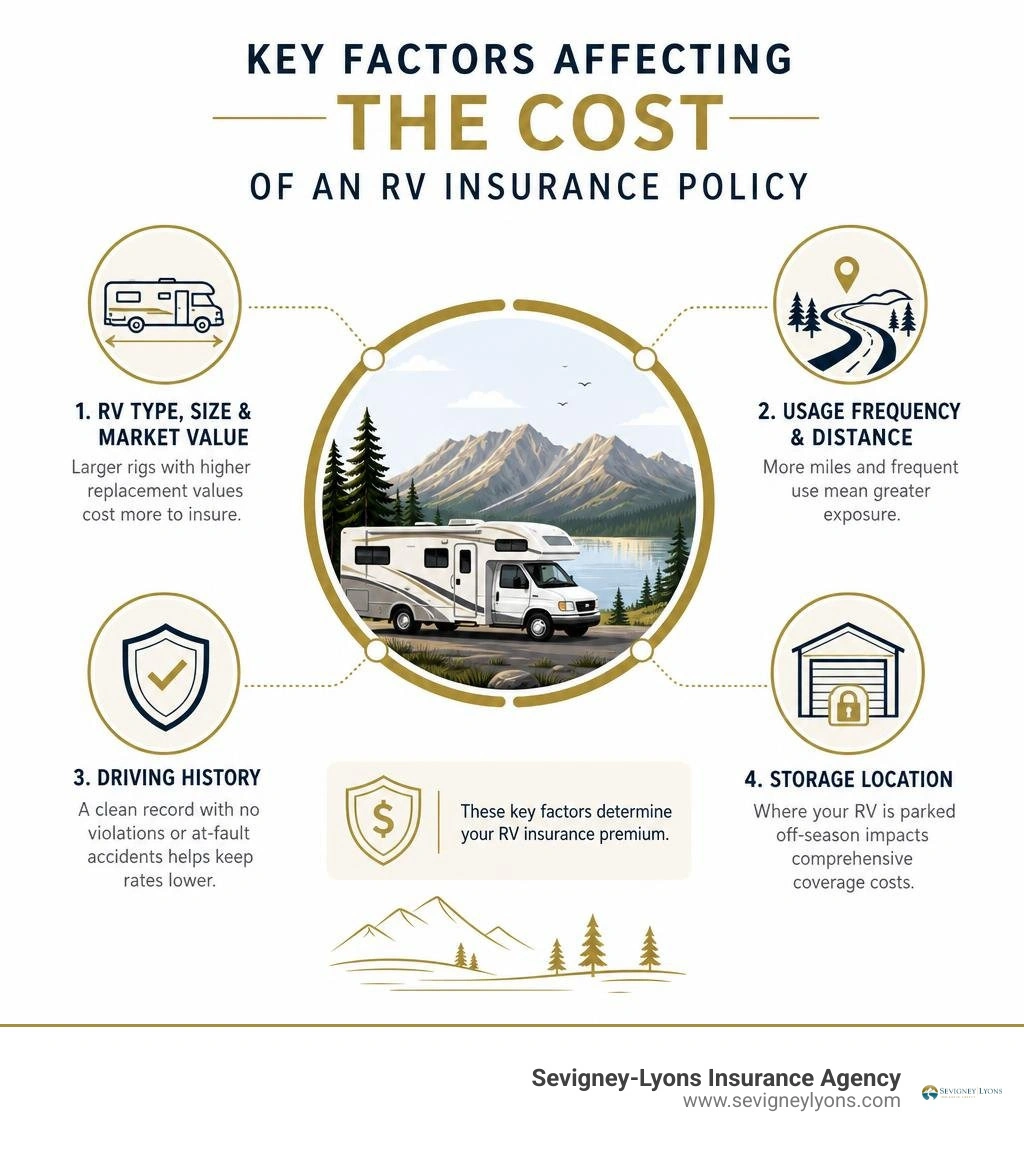
The primary cost drivers include:
- RV Type, Size, and Market Value: Drivable Class A rigs with high replacement values carry higher premiums than small towable pop-up trailers.
- Usage Frequency and Distance: A vehicle driven 15,000 miles a year across country routes carries more exposure than a camper driven twice a season from Kennebunk to local state parks.
- Driving History: A clean driving record free of moving violations and at-fault accidents keeps rates manageable.
- Storage Location: Where your rig is parked during off-season months impacts comprehensive rates (e.g., indoor secure facilities vs. open driveways in Biddeford).
Essential Discounts for Maine RV Insurance
While specialized protection is vital, you shouldn't pay a penny more than necessary. We regularly help our clients capture significant premium savings by taking advantage of smart discounting strategies:
- Multi-Policy Bundling: Combining your RV policy with your personal auto, home, or motorcycle insurance with the same carrier can yield auto savings around 5% and multi-vehicle discounts up to 20% annually. Additionally, bundling tow vehicles and trailers under one policy often unlocks a single deductible benefit if both are damaged in the same incident.
- Storage Savings Option (Lay-Up Option): If you store your camper during cold Maine winters, you don't need active collision or roadway liability coverage while the rig sits safely on blocks. By suspending collision and liability protections while keeping comprehensive coverage active (protecting against snow load, fire, and theft), you can cut premium costs by up to 53% during non-use months.
- Original Owner Discount: Many insurers grant special rate reductions to policyholders who purchased their RV brand-new directly from the dealership, regardless of the vehicle's current age.
- Advanced Quote Discount: Shopping ahead pays off. Securing your policy quote at least one day prior to the effective start date unlocks advance purchase discounts.
- Responsible Driver Savings: Maintaining a clean three-year driving record free of traffic tickets and accidents earns significant safe-driver rate reductions.
Frequently Asked Questions
Does coverage apply while parked at a campsite?
Yes, provided you have vacation liability or full-timer liability included in your policy. Vacation liability is specifically engineered for stationary risks while parked at a campsite, park, or vacation location. Standard limits start around $10,000 and can be upgraded up to $500,000. It covers medical expenses and legal claims if a guest trips over your patio mat, gets burned at your campfire, or suffers an injury inside your living quarters.
How does the storage savings option work during winter?
The storage savings option (often called an off-season lay-up period) allows seasonal campers in places like Wells and Biddeford to drastically lower premiums during winter months. When your rig is winterized and parked for the season, you temporarily suspend driving coverages like collision and roadway liability. However, comprehensive coverage remains fully active to protect against falling ice, heavy snow load collapse, rodent damage, fire, and storage unit theft. When spring arrives, you simply notify your agent to reactivate full road coverages before your first trip.
Is water damage from roof leaks covered?
Standard comprehensive policies cover sudden and accidental water damage—such as a fallen tree branch puncturing your roof membrane during a storm. However, standard policies explicitly exclude gradual water damage caused by rot, poor maintenance, or dry-rotted sealant seams. To protect against these issues, specialized endorsements like Roof Protection Plus cover roof seam failures and wear-and-tear leak repairs with a simple $250 deductible, provided your RV is less than six years old.
Conclusion
Finding the ideal insurance policy for your motorhome or trailer doesn't have to be overwhelming. As an independent insurance agency deeply rooted in Southern Maine—with convenient offices in Wells, Kennebunk, Ogunquit, and Biddeford—our team at Sevigney-Lyons Insurance Agency understands the unique needs of local outdoor enthusiasts.
Rather than fitting your complex recreational vehicle into a rigid, one-size-fits-all policy, we work with over 20 top-rated regional and national carriers to customize coverage built specifically for your lifestyle and budget. Whether you're planning weekend trips along the coast or embarking on a full-time cross-country journey, we are here to protect what matters most.
Ready to hit the open road with complete peace of mind? Get a Free Maine RV Insurance Quote today or give our local experts a call to compare options!