Blog Content
Why Getting a Cargo Insurance Quote Online Can Save You Time and Money
Getting a cargo insurance quote online is faster than most business owners expect. If you haul freight, ship goods, or manage a fleet in Maine — from Biddeford up through Kennebunk and Wells — here's what you need to know right now:
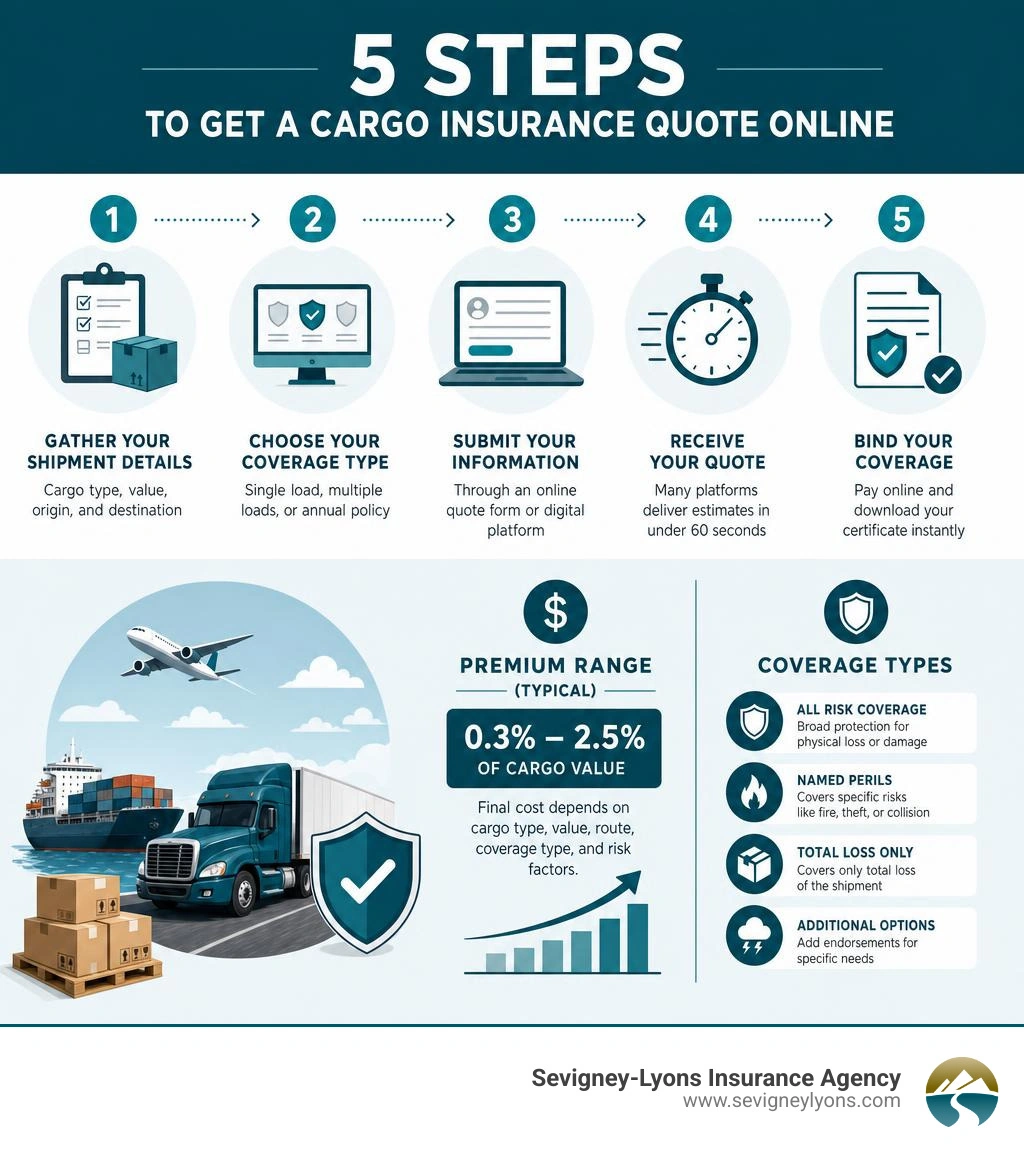
How to get a cargo insurance quote online (quick answer):
- Gather your shipment details — cargo type, value, origin, and destination
- Choose your coverage type — single load, multiple loads, or annual policy
- Submit your information through an online quote form or digital platform
- Receive your quote — many platforms deliver estimates in under 60 seconds
- Bind your coverage — pay online and download your certificate instantly
Sounds simple. But most small business owners in Southern Maine still waste hours on phone calls and paperwork — or worse, they skip cargo coverage entirely and rely on carrier liability alone.
That's a costly mistake. Carrier liability is severely limited and often pays out based on weight, not value. A damaged shipment worth thousands could result in a payout of just a few hundred dollars.
The good news? The process has changed. Online platforms and independent agencies now make it possible to compare rates, choose coverage, and get insured fast — without the traditional headache.
What is Cargo Insurance and Why Do Maine Shippers Need It?
When you operate a shipping, logistics, or contracting business in Southern Maine, your cargo is your reputation on wheels. Whether you are transporting fresh seafood from the docks of Portland, moving manufactured goods down Route 1 through Ogunquit, or delivering construction supplies to a job site in Wells, the items in transit face a barrage of risks.
Cargo insurance provides dedicated financial protection for physical loss or damage to freight during transit, loading, and unloading. If a collision, fire, theft, or sudden weather event destroys your cargo, this coverage steps in to pay for the value of the lost goods, cleanup costs, and even unrecoverable freight charges.
Many local business owners assume their standard commercial auto policy covers the items in the back of their trucks. In reality, basic auto policies protect the vehicle itself and cover third-party liability, but they completely exclude the cargo you haul for others. To understand how these coverages interact, it is highly recommended to read our comprehensive Commercial Auto Insurance Maine Guide to make sure your business has no hidden coverage gaps.
Without a dedicated cargo policy, a single highway accident near Kennebunk could leave your business on the hook for tens of thousands of dollars in ruined inventory. Furthermore, modern shippers and risk managers are increasingly strict; most will not even award you a contract unless you can present a valid certificate of cargo insurance.
How Cargo Insurance Protects Against Carrier Liability Limitations
A common trap for new shippers is relying entirely on "carrier liability." Legally, carriers are responsible for the goods they transport, but their financial liability is strictly capped by international and domestic conventions. These limits are almost always calculated by the weight of the shipment rather than its actual market value:
- Air Freight (Montreal Convention): Airline liability is generally limited to Special Drawing Rights (SDR) 19 per kilogram (roughly USD $26.22 per kilo).
- Sea Freight (Hague-Visby Rules): Ocean carriers pay a fraction of the cargo's value, often capped per package or shipping unit.
- Road Transport (CMR Convention / Domestic Tariffs): Interstate and local trucking limits are often as low as $0.50 per pound.
To see how disastrous this can be, consider a real-world scenario. Imagine you are shipping five boxes of high-end electronic components from Portland to a buyer. The shipment weighs 89 kilograms (about 196 pounds) but has a true market value of $39,500.
If those boxes are completely destroyed or stolen in transit, a carrier operating under standard international air liability limits would only pay you approximately $2,333. However, if you had secured a dedicated cargo policy, your insurance payout would cover the full $39,105 (the cargo value minus a nominal deductible).
Dedicated cargo insurance shifts the risk away from these restrictive weight-based limits, ensuring you are reimbursed for what the cargo is actually worth, not what it weighs on a scale.
How to Secure a Cargo Insurance Quote Online in Maine Instantly
The days of waiting weeks for an underwriter to manually review a paper application are gone. Today, the insurance industry utilizes advanced digital platforms to analyze risk in real-time. By leveraging automated underwriting, you can get a highly accurate cargo insurance quote online in less than 60 seconds.
These online quoting tools allow you to input your shipment parameters, compare different deductibles, and instantly buy coverage. If you want to run the numbers before speaking to an agent, utilizing an interactive online calculator is an excellent way to see how cargo value and transportation modes influence your estimated premium.
For business owners in Biddeford, Ogunquit, and Portland, this speed is a game-changer. If a client calls you with a last-minute, high-value shipment, you can secure the necessary coverage and download your proof of insurance right from your smartphone before the truck even leaves the yard.

Step-by-Step Guide to Requesting Your Cargo Insurance Quote Online
Ready to get a quote? Follow this straightforward process to ensure your online application goes smoothly and yields the most accurate pricing:
- Enter Shipment & Policyholder Details: Provide your basic business information, including your legal business name and operating address.
- Specify the Origin and Destination: Clearly state where the cargo is coming from and where it is going. For domestic shipments, this includes zip codes; for international freight, you will need the specific ports of loading and discharge.
- Describe the Commodity: Accurately select the commodity category. Insurance platforms use standardized Harmonized System (HS) codes to categorize cargo. Be specific — shipping raw lumber carries a different risk profile than shipping temperature-sensitive pharmaceuticals.
- Declare the Cargo Value & Freight Costs: Input the total commercial invoice value of the goods, plus the cost of the freight itself.
- Select Your Transport Mode: Indicate whether the cargo is moving via domestic trucking, air freight, ocean vessel, or a multimodal combination. If you are hauling the goods yourself using company-owned vehicles, you will want to make sure your vehicle policies are aligned by checking our guide on Commercial Auto Insurance Coverage.
- Review and Bind: Choose your deductible level, add any necessary coverage endorsements, and submit. Once approved, you can pay via credit card or e-wallet and instantly download your certificate of insurance.
Key Factors That Affect Your Cargo Insurance Quote Online Premium
When you request a cargo insurance quote online, the digital underwriting system calculates your premium based on several key risk variables:
- Cargo Type & Nature: Fragile, high-theft, or hazardous materials (like consumer electronics, fine art, or chemicals) command higher rates than durable goods (like textiles or steel).
- Standard Rate Bands: Licensed marine cargo brokers typically price standard transit coverage between 0.10% and 0.25% of the total cargo value. For example, insuring a $100,000 shipment of general merchandise could cost as little as $100 to $250.
- Shipment Frequency: If you only ship occasionally, a "per-load" or transactional policy is highly cost-effective. However, if you run a continuous logistics operation out of Kennebunk, structuring an annual open policy will dramatically lower your cost-per-shipment.
- Selected Deductibles: Choosing a higher deductible (such as $1,000 or $2,500 instead of $500) lowers your premium but increases your out-of-pocket responsibility in the event of a claim.
- Optional Add-ons: Customizing your policy with specialized protections will add a small percentage to your base rate:
- War & Strike Cover: Adds roughly +0.03% to 0.08% (highly recommended for international maritime routes).
- Temperature Control (Reefer Breakdown): Adds +0.03% to 0.07% for perishable food or pharmaceutical shipments.
- Delay Cover: Adds +0.02% to 0.05% to protect against financial losses from shipping delays.
If you operate multiple delivery vehicles to transport your cargo, consolidating your coverage can lead to significant savings. Learn how to manage these multi-vehicle risks by reading our resource on Commercial Vehicle Fleet Insurance.
Types of Cargo Coverage and Key Exclusions to Watch For
When shopping for cargo insurance online, you will generally choose between two primary coverage forms: All-Risk Coverage and Named Perils Coverage.
All-Risk coverage (often referred to as ICC Clause A) is the broadest protection available. It covers physical loss or damage from any external cause, unless the specific cause is explicitly excluded in the policy wording. Named Perils coverage, on the other hand, only covers losses resulting from events specifically listed in the policy (such as a vehicle collision, derailment, or fire).
For businesses transporting temperature-sensitive cargo — such as Maine lobsters or frozen goods — adding Refrigeration Breakdown Coverage is vital. This endorsement protects against spoilage if your truck’s mechanical refrigeration unit fails during transit.
To determine which policy structure fits your business model, compare the two primary methods of buying cargo insurance:
No matter which structure you choose, establishing a solid foundational business entity is crucial for liability management. If you are operating a local enterprise, protect your personal assets by reading our guide on setting up Business Insurance for a Maine LLC and check out our Small Business Insurance Maine Guide to round out your commercial protections.
Common Exclusions and Vehicle Eligibility Restrictions
While cargo insurance is incredibly broad, no policy covers absolutely everything. It is critical to read the fine print of your quote to understand what is excluded from coverage. Standard exclusions typically include:
- High-Value Valuables: Cash, deeds, fine jewelry, precious stones, and rare artwork are almost always excluded unless written on a specialized specie policy.
- Live Animals: Standard cargo policies do not cover the death or injury of live animals during transport.
- Improper Packing: If the shipper fails to pack the goods securely and they are damaged due to normal road vibrations, the insurer will deny the claim.
- Excessive Storage Times: Most standard transit policies only cover cargo while it is actively in the ordinary course of transit. If the cargo is stored in a warehouse or trailer for more than 72 hours without a specific storage extension, coverage will lapse.
- Prohibited Commodities: Radioactive materials, explosives, and illegal substances are universally excluded.
Additionally, certain vehicles may be excluded from coverage depending on their condition, age, or classification. To make sure your vehicles are fully compliant and eligible for commercial coverage, consult our specialized guide on Commercial Auto Insurance for Contractors.
Frequently Asked Questions About Cargo Insurance
How do claims work with online cargo insurance providers?
Modern online cargo insurance claims are handled through streamlined digital portals, which is a massive upgrade over traditional claims that often take two to three months to resolve.
When a loss occurs, you submit your claim online by uploading the required documentation: the bill of lading, photos of the damaged cargo, the commercial invoice showing the value of the goods, and a copy of the written notice of claim sent to the carrier. Digital-first platforms and modern MGAs utilize automated claims processing to settle standard claims in days — and in some cases, process digital payouts in just minutes once approved.
What is the difference between cargo insurance and commercial auto liability?
These two coverages protect completely different aspects of your business operations:
- Commercial Auto Liability protects your business if your truck causes an accident that results in bodily injury or physical damage to third-party property (such as another person's car or a guardrail).
- Cargo Insurance protects the actual goods and commodities belonging to others that you are hauling inside or on top of your vehicle.
To ensure your business has a complete safety net, it is helpful to look at the broader picture of Business Insurance options to protect both your vehicles and the physical assets you transport.
Which vehicles and cargo types are eligible for online coverage?
A wide variety of commercial vehicles are fully eligible for online cargo coverage, including standard box trucks, cargo vans, flatbeds, tractor-trailers, dually pickups, and most commercial trailers.
For-hire truckers and owner-operators can easily secure coverage for general freight, dry goods, building materials, and temperature-controlled foods. Most standard commercial vehicles and cargo types are fully eligible for coverage under standard guidelines.
Conclusion
Securing a cargo insurance quote online doesn't have to be a headache. By understanding your shipment values, choosing the right coverage structure, and working with experienced professionals, you can protect your business from devastating transit losses.
At Sevigney-Lyons Insurance Agency, we combine the speed of modern digital quoting with the unmatched care of a local, independent agency. With physical offices across Southern Maine — including Wells, Ogunquit, Kennebunk, Biddeford, and Portland — we have deep roots in our communities. We partner with over 20 of the nation's top insurance carriers to build tailored, cost-effective commercial policies that protect your cargo, your fleet, and your livelihood.
Don't leave your cargo's safety to chance or rely on weak carrier liability limits. Contact our team of local commercial insurance experts today, or take the first step right now by visiting our page to Get a Free Maine Insurance Quote.