Blog Content
What Is a Cargo Insurance Quote — and Why It Matters for Your Business
A cargo insurance quote is an estimate of what you'll pay to protect the goods you ship, haul, or receive from damage, theft, or loss in transit. If you're a small business owner in Maine — whether you're moving products out of Biddeford, receiving freight in Kennebunk, or managing a fleet along the Southern Maine coast — understanding cargo insurance is one of the most important steps you can take to protect your business finances.
Here's what you need to know right away:
- What it covers: Cargo insurance protects the value of goods while they're being transported — by truck, ship, or air
- Who needs it: For-hire truckers, shippers, importers, exporters, and freight brokers
- How much it costs: Typically $500–$2,000 per year for a $100,000 policy limit; annual all-risk policies can start as low as $650
- What carrier liability pays: Often just $0.60 per pound — far less than the actual value of most goods
- How to get a quote: Online, by phone, or through a local independent insurance agent
Many business owners assume their carrier's standard liability coverage is enough. It usually isn't. If a shipment is damaged or lost, carrier liability often pays only a fraction of what your goods are actually worth — based on weight, not value. That gap can mean a serious financial loss for your business.
This guide walks you through everything you need to know before requesting a cargo insurance quote — from policy types and cost factors to exclusions and the claims process — so you can make a confident, informed decision.
Cargo Insurance vs. Carrier Liability: Protecting Your Bottom Line
When we talk to business owners in Wells or Portland, one of the biggest points of confusion is the difference between carrier liability and a dedicated cargo insurance policy. It sounds like they do the same thing, but in logistics, they are worlds apart.
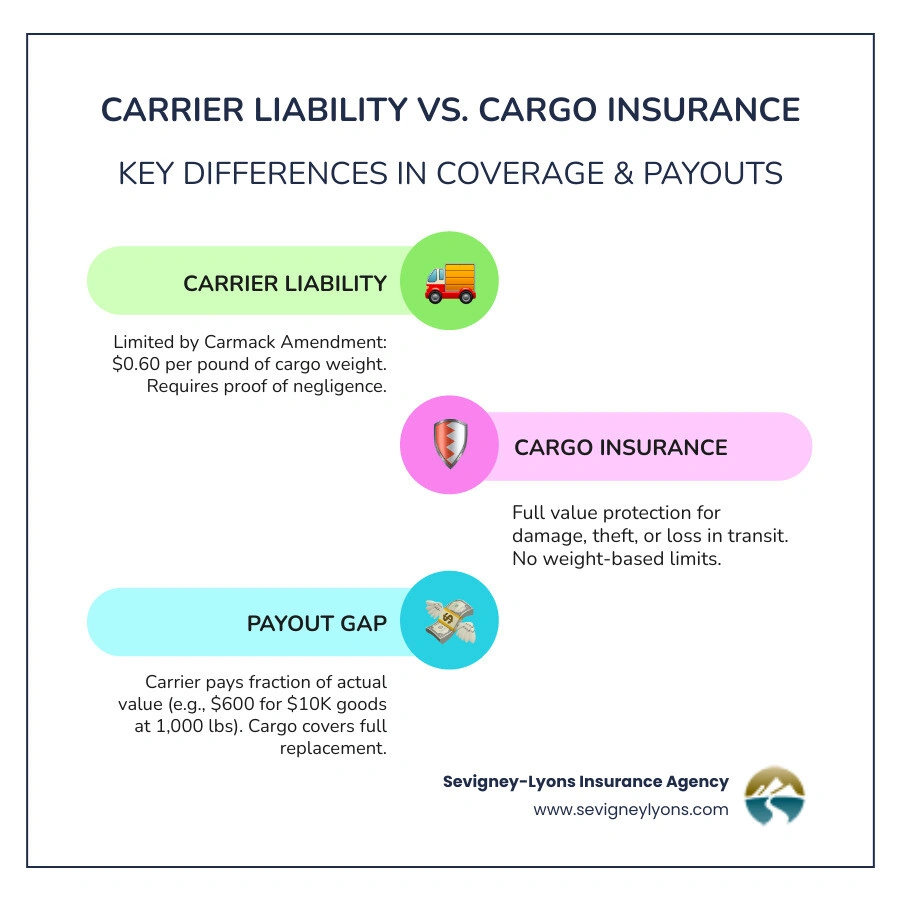
Carrier liability is governed by the Carmack Amendment, a law that limits the financial responsibility of carriers. Under a standard Bill of Lading, a carrier is generally only liable if you can prove they were negligent. Even then, the payouts are often "fractional." For land transport, this often defaults to a meager $0.60 per pound.
Imagine you are shipping $50,000 worth of high-end electronics from a warehouse in Biddeford. If that pallet weighs 200 pounds and the truck is involved in an accident, carrier liability might only offer you $120. That is a $49,880 loss that stays on your books.
Full-value cargo insurance, on the other hand, is "primary" coverage. It pays based on the actual value of the goods, not their weight. You don't have to spend months proving the carrier was at fault; if the goods are damaged by a covered peril, the policy responds. For a deeper look at how this fits into your overall fleet protection, check out our Commercial Auto Insurance Maine Guide.
Carrier Liability vs. Cargo Insurance Comparison
Essential Factors That Influence Your Cargo Insurance Quote
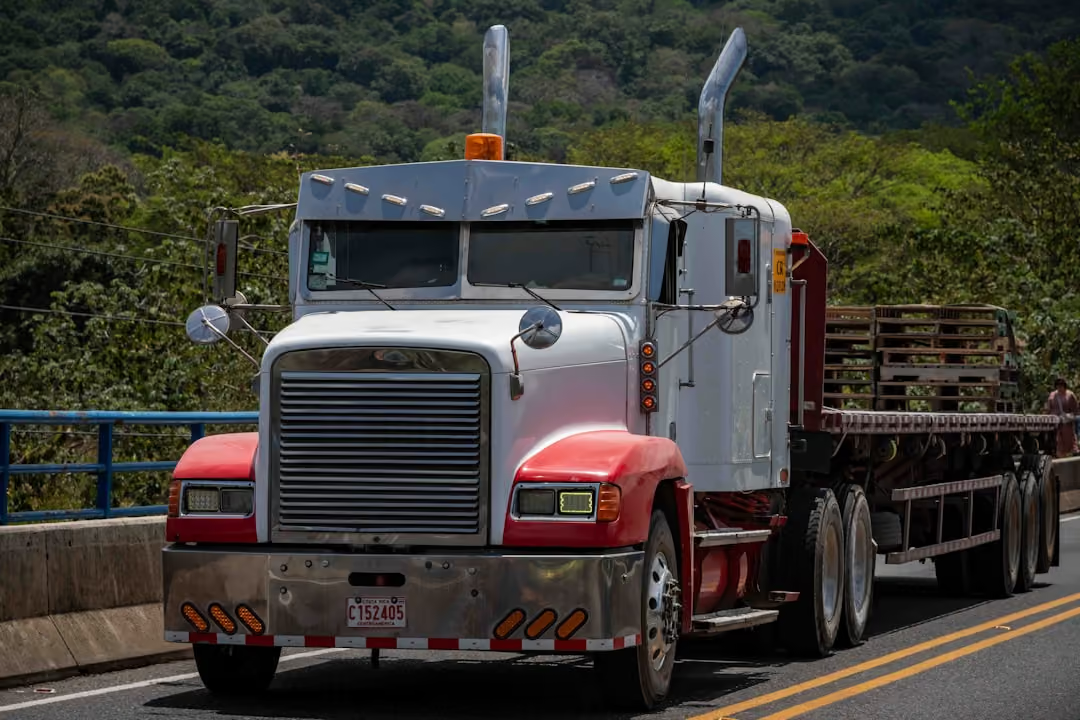
Getting a cargo insurance quote isn't a one-size-fits-all process. Because we live and work in Southern Maine, we know that a lobster wholesaler in Kennebunk has very different risks than a furniture manufacturer in Biddeford. When you ask for a quote, underwriters look at several "risk levers" to determine your premium.
How Your Cargo Type Impacts a Cargo Insurance Quote
The "what" matters just as much as the "how." Not all freight is created equal in the eyes of an insurer.
- General Freight: Standard dry goods like clothing or paper products are the easiest to insure and usually carry lower premiums.
- Hazardous Materials: If you're hauling chemicals or fuel through the Maine turnpike, expect higher rates due to the environmental cleanup risks involved.
- High-Value Items: Electronics, jewelry, and fine art require specialized "target commodity" riders.
- Household Goods: For-hire movers have specific federal requirements. The FMCSA mandates a minimum of $5,000 per vehicle for interstate household goods carriers.
If you are a local carrier, ensuring your vehicle is properly listed is step one. You can learn more about vehicle-specific coverage on our Commercial Auto Insurance Maine page.
Why Local Maine Routes Affect Your Cargo Insurance Quote
Geography plays a starring role in your premium. Maine presents unique challenges that underwriters consider:
- Wells and Kennebunk Logistics: These areas are hubs for local distribution. Frequent stopping and starting in high-traffic tourist zones can slightly increase the risk of minor collisions.
- Ogunquit Seasonal Risks: During the height of summer, the congestion on Route 1 increases the likelihood of accidents. Conversely, winter weather in Maine brings the risk of sliding off icy roads, which is a major factor in "collision and overturn" coverage.
- Biddeford Industrial Corridors: Proximity to major highways and industrial zones can actually help lower rates if the routes are well-maintained and have lower theft statistics.
For more information on how your local operations impact your business coverage, see our guide on Maine Commercial Auto Insurance.
Understanding Policy Types, Add-ons, and Common Exclusions
When you receive a cargo insurance quote, you'll usually see two main options: All-Risk and Named Perils.
All-Risk Coverage is the gold standard. It covers any physical loss or damage from an external cause unless specifically excluded. Named Perils, on the other hand, only covers exactly what is listed in the policy (like fire, windstorm, or collision). If your cargo is damaged by something not on that list, you're out of luck.
Depending on your business, you might need different policy formats:
- Motor Truck Cargo: Specifically for for-hire truckers hauling the property of others.
- Ocean Cargo: For our Maine importers and exporters using the Port of Portland or international lanes.
- Air Freight: For time-sensitive, high-value shipments.
If you store goods as part of your transport business, you may also need to look at Commercial Property Insurance Comp Guide to ensure your warehouse is as protected as your trucks.
Primary vs. Contingent Cargo Insurance Quote Differences
This is a vital distinction for freight brokers and shippers.
- Primary Cargo Insurance: This is the main policy that pays out first. If you are a trucker, this is what you carry to protect your clients' goods.
- Contingent Cargo Insurance: This is a "backup" policy typically purchased by brokers. If a carrier's primary insurance fails to pay (perhaps due to a policy cancellation or a specific exclusion), the contingent policy kicks in to protect the broker's liability.
Choosing the right provider is key to ensuring these policies work together. You can compare options through our Business Auto Insurance Providers resource.
Essential Add-ons: Reefer Breakdown and Infidelity
Standard policies have gaps. In Maine, where we ship a lot of perishable food, these add-ons are non-negotiable:
- Reefer Breakdown: Covers spoilage if your refrigeration unit fails. This is crucial for Maine’s seafood and produce industries.
- Infidelity/Dishonesty: Standard policies often exclude theft committed by your own employees. This rider closes that gap.
- Debris Removal and Pollution: If a truck overturns in Wells and spills cargo across the road, you are responsible for the cleanup. Some policies include up to $10,000 for pollution removal in addition to the policy limit.
To understand how to protect the physical assets where these goods are stored, visit Business Property Insurance Maine.
Navigating the Cargo Insurance Claims Process in 2026
In April 2026, the claims process has become significantly more streamlined. Modern providers often use integrated portals that pull data directly from your shipping software.
What to expect during a claim:
- Speed: On average, claims are now resolved within 7–10 days, with payouts hitting bank accounts just a few days later.
- Evidence: You’ll still need the Bill of Lading, photos of the damage, and the commercial invoice.
- Salvage: The insurance company usually has the right to "salvage" the goods (selling what’s left to recoup costs).
- Unrecoverable Freight: A good policy will also reimburse you for the freight charges you couldn't collect because the load wasn't delivered.
Frequently Asked Questions
Is cargo insurance legally required for Maine truckers?
Technically, the FMCSA does not require cargo insurance for most for-hire carriers. However, there is a big exception: Interstate household goods movers must carry at least $5,000 per vehicle and $10,000 per occurrence.
Even if it isn't legally required for your specific cargo, it is contractually required. Almost every reputable shipper or broker in Maine will refuse to work with you unless you show proof of at least $100,000 in cargo coverage. If you are a contractor looking to expand your fleet, see our Commercial Auto Insurance for Contractor guide.
What are the most common cargo insurance exclusions?
Every policy has "fine print." Common exclusions include:
- Unattended Vehicles: Many policies won't pay if the truck was left unlocked or parked in an unsecure area for an extended time.
- The 72-Hour Rule: Cargo is usually only covered while "in the ordinary course of transit." If it sits in a trailer for more than 72 hours without moving, coverage often ceases.
- Inherent Vice: This is insurance-speak for "the goods destroyed themselves." For example, if you ship fruit that was already overripe and it rots, that's not a covered loss.
- High-Risk Items: Standard quotes often exclude jewelry, tobacco, live animals, and fine art unless specifically added.
How much does a typical cargo insurance policy cost?
For most motor carriers, a cargo insurance quote for a $100,000 limit will fall between $500 and $2,000 per year.
- Minimum Premiums: Some specialized "all-risk" annual policies start as low as $650.
- Savings Tip: You can often lower your premium by choosing a higher deductible (standard is $1,000) or by installing safety equipment like dash cams and GPS tracking.
Conclusion
Requesting a cargo insurance quote is about more than just checking a box for a broker; it’s about ensuring that a single bad day on the I-95 doesn’t put your Maine business out of commission.
At Sevigney-Lyons Insurance Agency, we are proud of our deep community roots in Wells, Ogunquit, Kennebunk, Biddeford, and Portland. As an independent agency, we don't just work for one insurance company—we work for you. We have access to over 20 top carriers, allowing us to compare rates and find a policy tailored to the specific commodities you haul and the routes you drive.
Whether you're an owner-operator just starting out or a large fleet manager looking for better service and faster claims, we’re here to help.