Blog Content
Maine Radon Coverage: What Your Homeowners Policy Usually Does Not Pay For
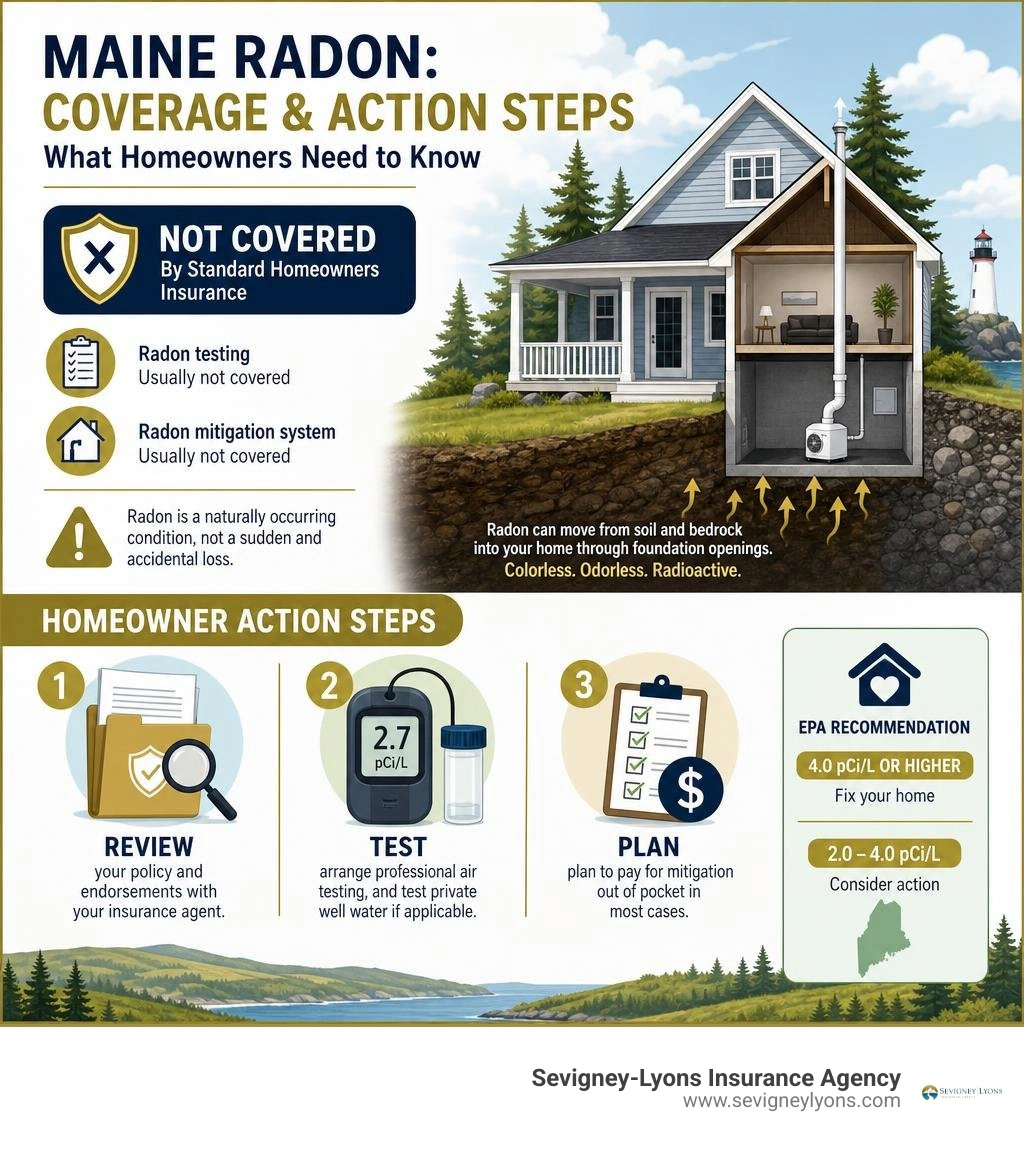
Standard Maine homeowners insurance policies generally do not cover radon testing or the cost to install a radon mitigation system. Radon is usually treated as a naturally occurring environmental condition, not a sudden and accidental loss such as a fire or burst pipe.
If a test in Wells, Kennebunk, Ogunquit, or Biddeford finds elevated radon, take these steps:
- Review your policy and endorsements with your insurance agent.
- Arrange professional air testing, and test private well water if applicable.
- Plan to pay for mitigation out of pocket in most cases.
This matters in Maine because radon can move from soil and bedrock into a home through foundation openings. It is colorless, odorless, and radioactive. The EPA recommends fixing a home at 4.0 pCi/L or higher and considering action between 2.0 and 4.0 pCi/L.
I am Jon Sevigney, and this guide will help you understand the insurance limits, practical next steps, and ways to protect your home’s health and value.
Glossary for do homeowners insurance policies in maine cover radon gas:
Do Homeowners Insurance Policies in Maine Cover Radon Gas?
When buying a home along the coast of Southern Maine or settling into a cozy historic property, discovering elevated radon gas can feel alarming. Many property owners immediately wonder: do homeowners insurance policies in maine cover radon gas remediation?
The short answer is no. Standard property insurance forms written across the state exclude both diagnostic testing and the installation of mitigation systems.

To understand this coverage denial, you have to look at the fundamental purpose of property coverage. Having Maine home insurance explained by a licensed agent makes it clear: property policies exist to protect against unforeseen, sudden, and accidental physical disasters. They are not designed to cover ongoing environmental maintenance or long-standing geological hazards present in the ground beneath your floorboards.
Understanding Why Do Homeowners Insurance Policies in Maine Cover Radon Gas Exclusions Apply
Insurance contracts, such as the standard HO-3 policy contract standards, protect structures against direct physical loss from specific perils like fire, lightning, explosion, and severe windstorms.
Radon gas does not cause sudden, visible structural damage. It does not crack rafters, smash windows, or tear shingles from your roof. Because radon seeps gradually through porous concrete and stone over months and years, insurance carriers categorize it as a pre-existing environmental condition.
Furthermore, standard dwelling coverage insurance applies only to the physical building structure itself. The underlying earth, bedrock, and soil gases beneath the foundation are explicitly defined as excluded property under Section I of typical home contracts.
Environmental Hazard Exclusions in Maine Policy Contracts
Every standard carrier policy contains strict exclusions regarding environmental contaminants and pollution. According to regulatory references such as the Maine Bureau of Insurance policy comparison, property forms exclude testing, monitoring, cleaning up, or containing pollutants.
In standard insurance terminology, pollutants encompass solid, liquid, or gaseous irritants and contaminants. Because subterranean radon is an environmental gas, policies exclude costs to test or remediate it. When evaluating your overall Maine hazard home insurance needs, it becomes evident that environmental health protections require direct homeowner action rather than an insurance claim.
Radon in Maine: Granite Geology, Bedrock Wells, and Health Risks
Radon is a naturally occurring radioactive gas produced by the decay of trace uranium found within natural rock. Southern Maine, particularly York County and surrounding coastal regions, sits atop massive granite formations. As these subterranean granite formations naturally break down, radon gas migrates upward through the soil.
The health risks are serious. Radon exposure is the second leading cause of lung cancer in the United States, responsible for approximately 21,000 deaths annually according to the EPA. Because it cannot be seen, tasted, or smelled, testing is the only way to detect its presence.
Why 1 in 3 Maine Homes Exceed EPA Action Levels
Statewide health studies show that approximately 1 in 3 Maine homes have indoor radon concentrations above the EPA’s 4.0 pCi/L action threshold.
During colder months in towns like Kennebunk and Biddeford, indoor heating systems create a natural vacuum known as the "stack effect." Warm air rises and escapes through upper levels, drawing soil gases straight up through basement slabs, dirt crawlspaces, and foundation cracks. Because homes are sealed tight against harsh winter temperatures, the gas gets trapped indoors, leading to elevated seasonal concentrations.
Air vs. Well Water Radon in Southern Maine
In coastal communities like Wells and Ogunquit, many homes rely on private bedrock wells drilled hundreds of feet into granite aquifers. Radon dissolves into this groundwater under pressure.

When running hot showers, laundry, or dishwashers, dissolved radon off-gases directly into indoor living areas. As a rule of thumb, every 10,000 pCi/L of radon present in well water adds roughly 1.0 pCi/L to your overall indoor air concentration. Treating water-borne radon is essential when aiming for safe indoor air quality.
Radon Mitigation Costs, System Types, and Financing Options
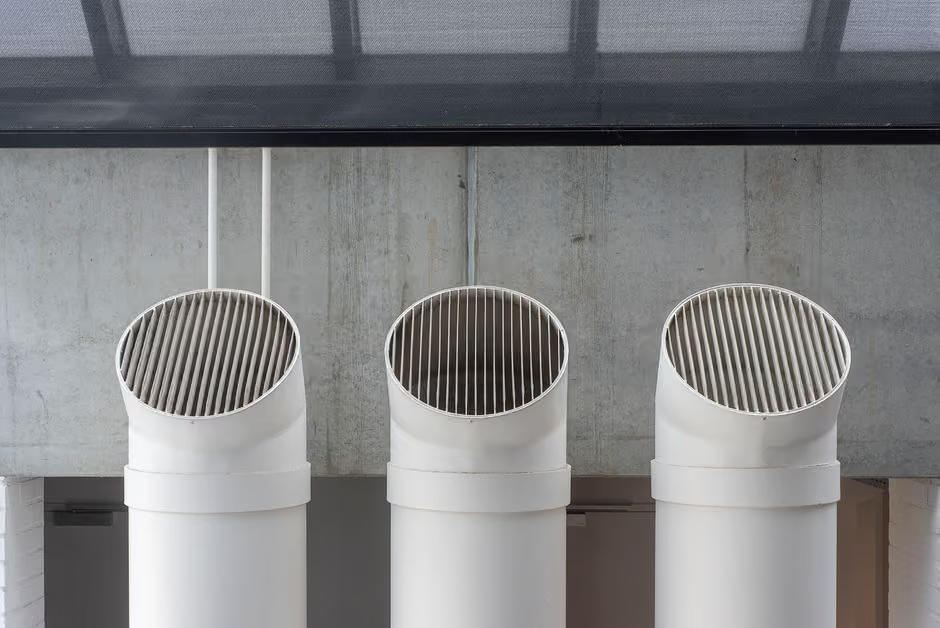
Resolving elevated radon is straightforward using proven mechanical systems. For indoor air, the most common solution is an active sub-slab depressurization system. A certified professional seals floor penetrations, inserts a PVC suction pipe beneath the basement slab, and routes it to an exterior or attic-mounted fan that exhausts the gas safely above the roofline.
Mitigation for well water typically involves installing an aeration system or a Granular Activated Carbon (GAC) filter directly at the point where water enters the home. When reviewing your overall Maine home insurance coverage options, these physical upgrades represent direct property maintenance investments.
How Do Homeowners Insurance Policies in Maine Cover Radon Gas Mitigation Compared to Out-of-Pocket Expenses?
Because insurance policies do not pay for these systems, property owners must budget for them directly. Balancing your Maine home insurance coverage limits with routine maintenance funds ensures you maintain both a protected and healthy property.
- Air Sub-Slab Systems: Standard residential installations range from $1,200 to $2,500 depending on foundation layout and suction points.
- Well Water Aeration Systems: Aeration units typically run between $3,000 and $6,000+.
- Water GAC Filters: Carbon filtration setups generally cost between $1,500 and $3,500.
- Operating & Upkeep: Continuous fans draw 50 to 150 watts of electricity (around $5 to $15 monthly) and last 5 to 10 years, with replacement fans costing approximately $300 to $600.
Available Financing and Assistance for Maine Homeowners
Maine does not currently provide a statewide grant program for private residential radon mitigation. However, several accessible avenues exist to finance installations:
- Efficiency Maine & Home Energy Loans: Unsecured energy and home improvement loans with competitive fixed interest rates.
- Home Equity Lines of Credit (HELOC): Utilizing home equity allows affordable financing for property preservation.
- Municipal Home Improvement Programs: Select Southern Maine communities offer localized low-interest rehabilitation loans for income-qualifying households.
- Contractor Payment Plans: Many regional mitigation specialists partner with consumer lenders to offer staged payment plans.
Maine Real Estate Transactions, Disclosures, and Property Value
Radon testing has become a standard contingency in Maine real estate transactions. Understanding local disclosure protocols prevents delays when buying or selling real estate.
Testing Protocols and Seller Disclosure Requirements
Maine property disclosure statutes require sellers to disclose known environmental hazards, including any past radon test results or installed mitigation equipment.
Testing during a real estate transaction typically involves placing continuous electronic radon monitors or calibrated short-term canisters in the lowest livable area for a minimum of 48 hours under closed-building conditions. If tests show levels at or above 4.0 pCi/L, buyers frequently request an escrow credit or ask the seller to hire a certified mitigator prior to closing.
How Mitigation Systems Affect Property Value in Kennebunk and Biddeford
An existing radon mitigation system is an asset, not a drawback. In communities like Kennebunk and Biddeford, educated buyers view an active depressurization system with documented post-mitigation readings below 2.0 pCi/L as proof of a well-maintained home. It removes uncertainty, simplifies inspection negotiations, and ensures immediate indoor safety for incoming families.
Frequently Asked Questions About Maine Homeowners Insurance and Radon
Will discovering radon gas cancel my Maine homeowners insurance policy?
No. Insurance carriers do not cancel property insurance policies or raise premium rates simply because elevated radon gas is detected during a routine inspection. Underwriters evaluate risks like roof age, electrical systems, and plumbing integrity when determining eligibility.
Can I buy a special insurance rider to cover radon mitigation in Maine?
No. Standard insurance carriers operating in Maine do not offer optional riders or endorsements covering radon testing or system installation. Mitigation remains an out-of-pocket home maintenance responsibility.
What should I do immediately after testing above 4.0 pCi/L in Maine?
Do not panic. Perform a follow-up test to confirm the reading, test your private well water if applicable, and contact a certified radon mitigation professional to design a system suited to your home's foundation.
Conclusion
Understanding how property insurance interacts with regional environmental hazards helps you make confident choices for your property. While standard policies do not cover radon abatement, managing indoor air quality is a cost-effective way to preserve your family's health and maintain your property's value.
At Sevigney-Lyons Insurance Agency, we believe in giving our neighbors across Wells, Kennebunk, Ogunquit, Biddeford, and all of Southern Maine the clear, honest advice they deserve. When you need the best homeowners insurance coverage in Maine, our team is here to tailor the right policy for your home. Reach out to us today to review your coverage.